
Why your home feels damp (and how to fix it)
Condensation, mould and common mistakes.

You wipe the condensation off the windows every morning. There's a musty smell in the bedroom. A dark patch keeps appearing behind the wardrobe, even after you've cleaned and painted it.
Something is keeping that part of your home wet.
Damp is one of the most frustrating household problems because several different causes can produce similar symptoms. A leaking roof, poor ventilation, cold walls and plumbing problems can all leave stains, peeling paint and mould behind.
The mistake is treating every damp patch the same way.
A dehumidifier might help with condensation but won't repair a leaking pipe. Opening windows may reduce indoor humidity but won't stop rain entering through damaged roofing. Painting over mould might hide it temporarily, but the growth can return if the underlying moisture remains.
This guide explains how to identify the likely source of damp, what you can fix yourself, when to call a professional and how to stop the problem returning.
Key rule: Damp is a symptom, not a diagnosis. Find out where the water is coming from before spending money on treatments.
Start by identifying the type of damp
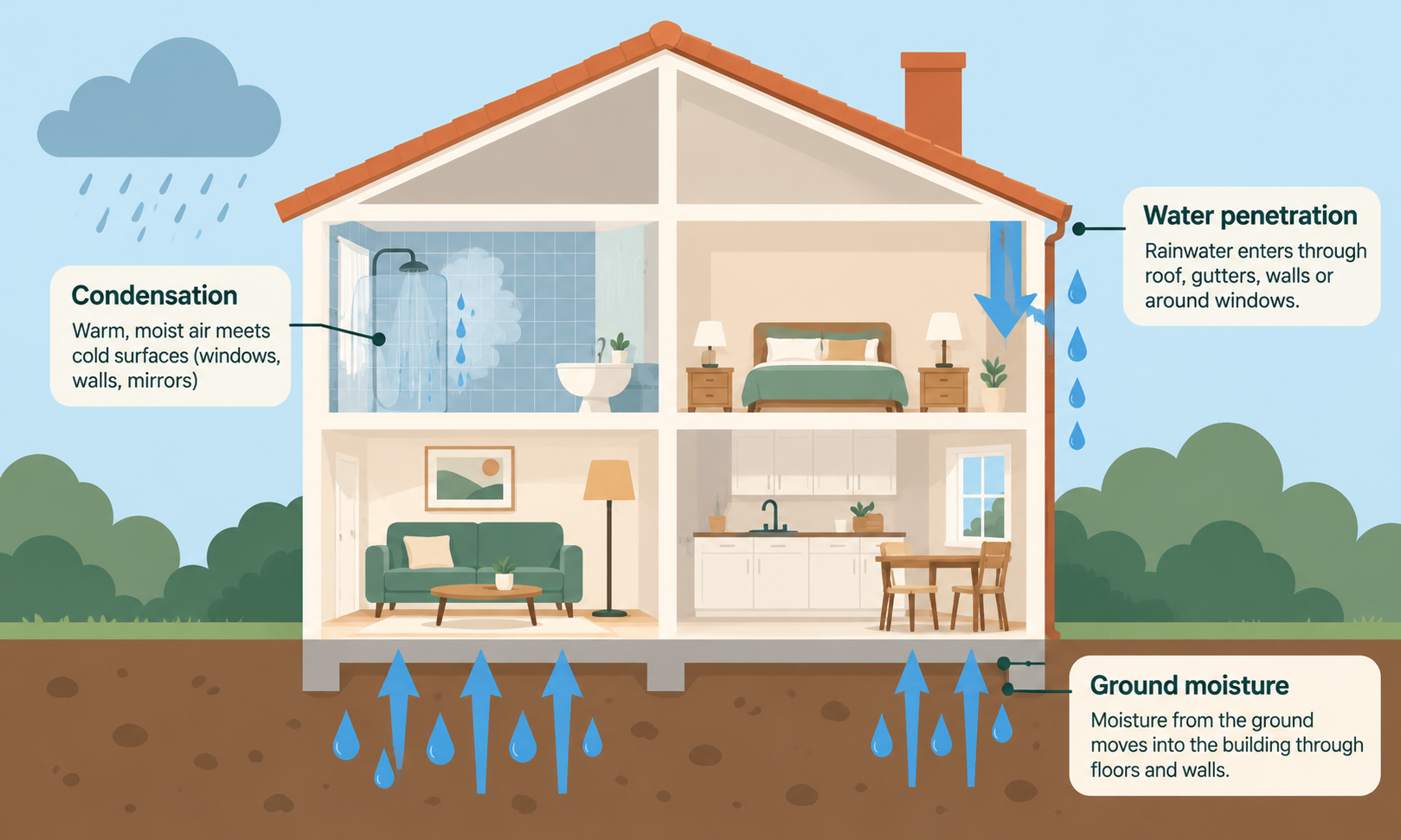
Before buying a dehumidifier or applying waterproof paint, look at where the moisture appears and when it becomes worse.
The three main categories are:
Condensation: Moisture from indoor air collects on cold surfaces.
Water penetration: Rainwater or plumbing leaks enter areas that should stay dry.
Ground moisture: Water from the ground moves into floors or walls because of drainage, construction or moisture-barrier problems.
A home can have more than one problem at the same time.
For example, a bedroom might have condensation on the windows while a separate roof leak causes a stain on the ceiling.
Here are some useful clues.
What you noticePossible causeWater on windows in the morningCondensationMould behind a wardrobe on an outside wallCondensation on a cold surface or hidden moistureDamp patch that worsens after rainRoof, gutter or wall leakStain below a bathroomPlumbing or waterproofing leakMoisture concentrated near the bottom of a ground-floor wallGround moisture, surface water or condensationMusty smell under flooringTrapped moisture or hidden water damageWater gathering near the foundationPoor drainage or groundwater problems
These are clues, not proof. More than one mechanism may be involved, and persistent dampness may need professional investigation.
1. Understand why condensation happens
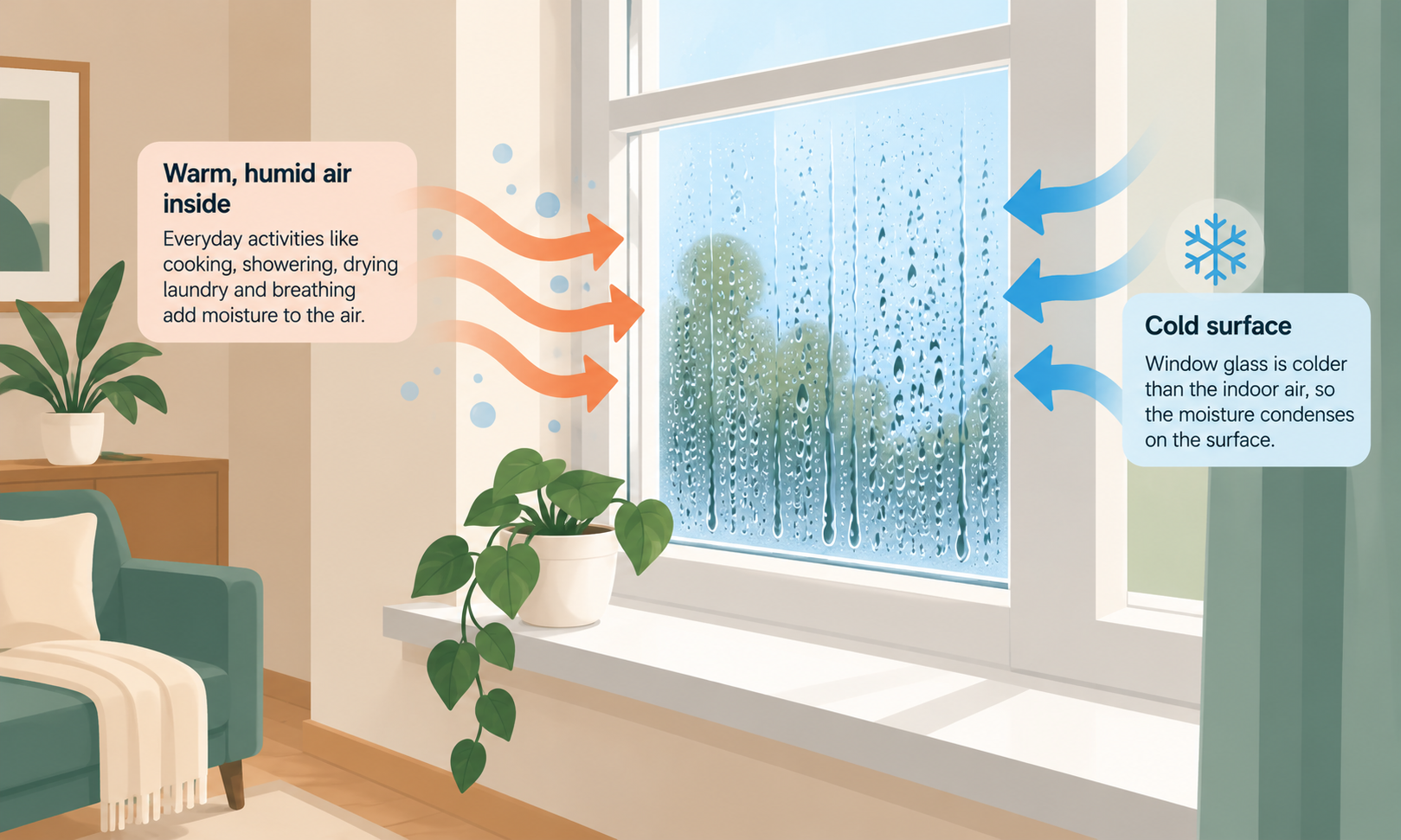
Condensation is one of the most common causes of moisture inside homes.
Air contains water vapour. When humid air touches a surface cold enough for that vapour to condense, droplets of water can form.
That's why windows sometimes become wet overnight.
The room's air might feel comfortable, but the window glass is much colder than the rest of the room.
The same process can occur on poorly insulated walls, around window frames, behind large furniture and in cold corners.
Where does the moisture come from?
Ordinary household activities continuously release moisture into the air.
Common sources include:
Showering and bathing.
Cooking and boiling water.
Drying laundry indoors.
Washing dishes.
Breathing and perspiration.
Certain unvented combustion appliances.
Moisture entering from leaks, crawl spaces or other building defects.
None of this means you should stop normal household activities.
The problem occurs when the moisture isn't removed or controlled effectively.
When does condensation become a problem?
A little condensation on a bathroom mirror after a shower isn't automatically a sign of a defective building.
But recurring condensation that leaves windowsills, walls or other surfaces wet deserves attention.
Persistent moisture can damage finishes and allow mould to grow.
Tip: Check your windows and cold corners first thing in the morning, before opening them or turning up the heating. Note where water collects and whether it dries during the day.
2. Check the humidity inside your home
You don't have to guess whether indoor air is too humid.
A hygrometer is a small device that measures relative humidity, usually expressed as a percentage.
Many inexpensive indoor thermometers include one.
For general household moisture management, a relative humidity range of around 30 to 50 percent is often a useful target, although comfort, climate and building conditions vary.
The US Environmental Protection Agency recommends keeping indoor relative humidity below 60 percent where possible, ideally between 30 and 50 percent.
That doesn't guarantee condensation will never form.
A very cold surface can collect moisture even when the room's average humidity appears reasonable.
How to measure humidity properly
Place the hygrometer away from direct sunlight, radiators, heaters and open windows.
Measure during different parts of the day.
For example:
Early morning, before ventilating the room.
After showering or cooking.
During the evening when windows are usually closed.
Look for patterns rather than reacting to one reading.
A temporary rise after a hot shower is different from a bedroom that remains very humid for days.
You can also compare readings between rooms.
If one bedroom consistently has higher humidity than the rest of the house, investigate its ventilation, temperature and any hidden moisture sources.
3. Improve ventilation where moisture is created
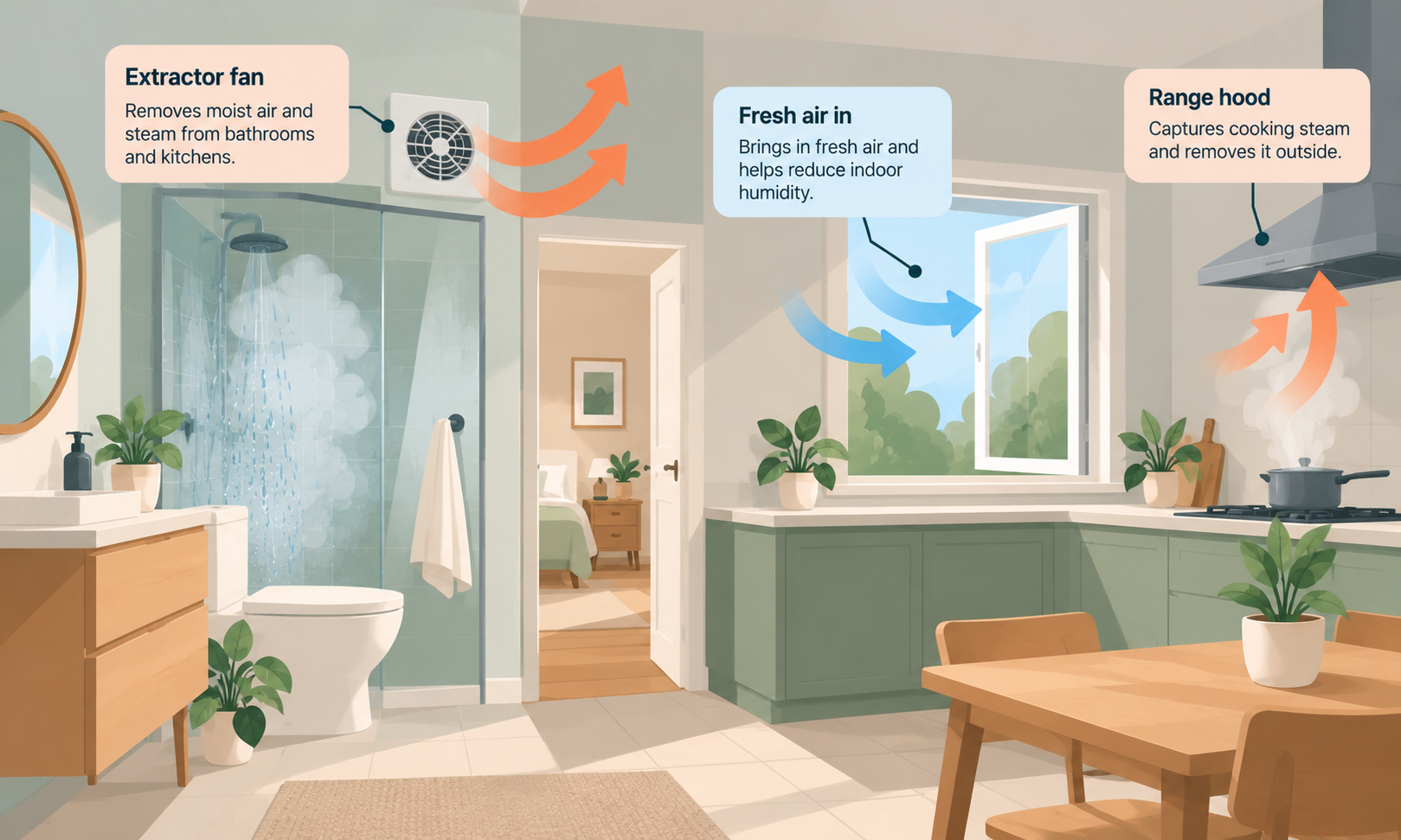
Ventilation removes moisture-laden indoor air and replaces it with fresh air.
Without adequate ventilation, humidity can accumulate even in a well-maintained home.
Start in kitchens, bathrooms and laundry areas.
Bathrooms
Use an extractor fan that vents outdoors when showering, and keep it running long enough afterward to remove excess moisture.
If there is no fan, open a window when conditions are suitable.
Keep the bathroom door closed during a shower if doing so prevents humid air from spreading into colder rooms.
Wipe or squeegee excess water from shower walls and other wet surfaces.
This reduces the amount of water left to evaporate.
Kitchens
Use a properly vented range hood where available.
Cover pots while cooking when practical.
Avoid allowing steam to accumulate for long periods in poorly ventilated rooms.
Some cooker hoods recirculate air through filters rather than exhausting it outside. These can help with certain cooking pollutants and odours but generally do not remove water vapour as effectively as a correctly installed external exhaust.
Bedrooms and living areas
Open windows periodically when outdoor conditions make ventilation useful.
Short periods of effective ventilation may be preferable to leaving a window slightly open all day during cold weather, depending on the building and climate.
Mechanical ventilation systems should be operated and maintained according to their design.
Keep air vents clear.
Don't block designed ventilation openings simply to eliminate drafts.
When opening windows isn't enough
In humid tropical or coastal climates, outdoor air may contain more moisture than indoor air.
Opening windows can sometimes increase indoor humidity rather than reduce it.
In those conditions, air conditioning, suitable mechanical ventilation or dehumidification may be more effective.
Tip: Don't confuse ventilation with uncontrolled drafts. Good ventilation provides an appropriate supply of fresh air without unnecessarily making the home cold or uncomfortable.
4. Stop cold walls from collecting moisture
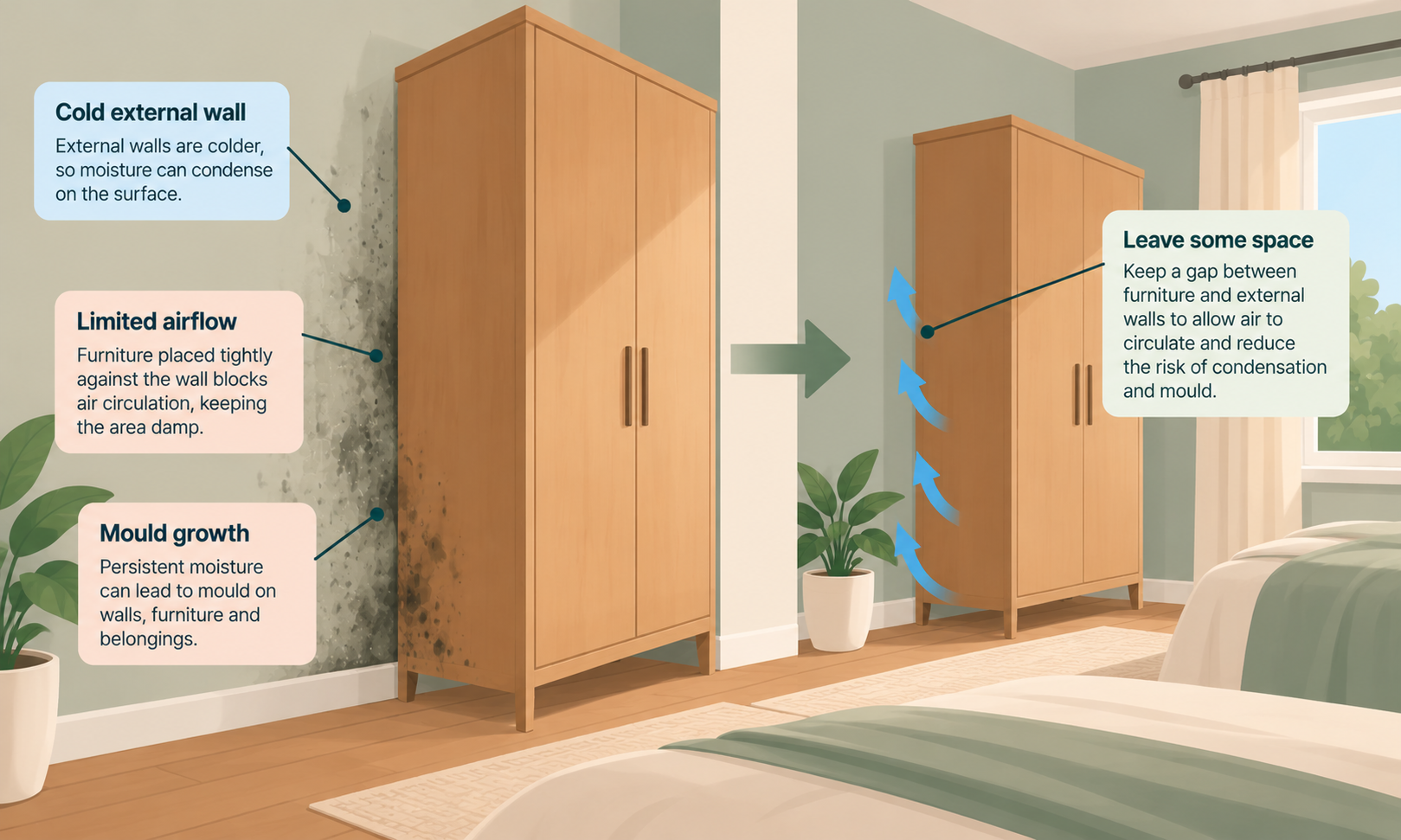
A wall doesn't have to leak to become damp.
When warm, humid indoor air reaches a sufficiently cold wall, condensation can occur on its surface.
This is particularly common in poorly insulated buildings.
Likely locations include:
External wall corners.
Areas around window frames.
Ceiling edges.
Walls behind wardrobes and sofas.
Sections where insulation is missing or interrupted.
These cold areas are sometimes associated with thermal bridges, where heat moves more readily through part of the building.
Why furniture placement matters
A wardrobe pushed tightly against a cold external wall can restrict air circulation.
The wall behind it may remain colder than the surrounding room.
If moisture collects there, mould can develop unnoticed.
Try moving large furniture slightly away from cold walls.
Leave enough space for air to circulate and for you to inspect the surface.
This won't fix every damp problem, but it can help with surface condensation.
Can insulation solve the problem?
Proper insulation can raise internal surface temperatures and reduce the likelihood of condensation.
However, insulation must be chosen and installed for the building and local climate.
Incorrect insulation, air sealing or vapour-control details can trap moisture inside building assemblies.
Before insulating a damp wall, find out whether the moisture comes from condensation, rainwater or another source.
Insulating over an active leak can make the problem harder to detect and repair.
5. Look for leaks before blaming humidity
Not every damp patch comes from indoor air.
Water may be entering through the roof, walls, plumbing or drainage system.
Look carefully at where the stain appears.
Roof and ceiling leaks
A brown ceiling stain, peeling paint or damp insulation may indicate water entering from above.
Possible causes include damaged roofing, failed flashing, blocked drainage or leaking pipes.
If the stain worsens after rainfall, investigate the roof and nearby exterior details.
Remember that water can travel along framing or other building materials before appearing on the ceiling.
The visible stain may not be directly beneath the original leak.
Exterior walls
Water can enter through damaged exterior finishes, cracks, poorly sealed openings and defective window flashing.
A damp patch that appears or expands after wind-driven rain is an important clue.
Plumbing leaks
Leaks around sinks, showers, toilets, washing machines and concealed pipes can remain hidden for a long time.
Warning signs include:
Persistent wetness under cabinets.
Swollen wood or damaged flooring.
Water stains on the ceiling below a bathroom.
Unexplained water use.
Dampness that remains regardless of the weather.
If you suspect a concealed leak, arrange an appropriate inspection.
A moisture meter or other diagnostic equipment may help locate affected areas, but readings need proper interpretation.
Don't keep repainting a wall that becomes wet again. Find the source first.
6. Check gutters, drainage and moisture near the ground
Dampness near the bottom of a wall is sometimes described as rising damp.
In some buildings, moisture can move upward through porous materials by capillary action.
But a low-level damp patch does not automatically prove rising damp.
Other possibilities include:
Rainwater collecting near the foundation.
Faulty gutters or downpipes.
Exterior ground levels that direct water toward the building.
Plumbing leaks.
Condensation on cold lower walls.
Moisture trapped by inappropriate finishes.
Defects in damp-proofing or foundation construction.
Different causes need different solutions.
Start outside
During safe conditions, inspect how rainwater moves around the building.
Check whether gutters overflow, downpipes discharge next to foundations or water pools against exterior walls.
Look for blocked drains and damaged drainage components.
Avoid climbing onto roofs or ladders in unsafe conditions.
Be cautious with expensive damp treatments
Some contractors may recommend chemical injections, waterproof coatings or other treatments based on limited observations.
Those products may be appropriate for specific diagnosed problems, but they are not universal solutions.
Ask what evidence identifies the moisture source and why the proposed method will correct it.
For persistent ground-level damp, an independent assessment from a qualified building professional may be worth the cost.
7. Understand why mould keeps returning

Mould needs suitable moisture and organic material to grow.
It can appear on paint, wallpaper, wood, dust, fabrics and other household surfaces.
It often develops in places where moisture remains for long periods.
Typical locations include:
Bathroom ceilings and grout.
Window seals and surrounding walls.
Bedroom corners.
Behind furniture.
Beneath carpets.
Around previously leaking pipes.
Inside water-damaged walls.
Cleaning visible mould without correcting the moisture problem rarely provides a lasting solution.
Does mould colour tell you how dangerous it is?
Not reliably.
Black, green, white and other colours can occur in different types of mould.
Colour alone cannot establish the species, exposure risk or seriousness of a contamination problem.
Instead of trying to identify mould by appearance, focus on the extent of growth, the moisture source and whether affected materials can be cleaned safely.
Can mould affect your health?
Yes.
The World Health Organization associates damp and mouldy indoor environments with increased respiratory symptoms, allergies and asthma-related problems.
Some people are more vulnerable, particularly those with asthma, allergies or weakened immune systems.
If you experience symptoms you believe may be related to indoor mould, consult a healthcare professional.
8. Clean small areas of mould safely
For limited surface mould on suitable hard, nonporous materials, cleaning may be manageable without hiring a specialist.
The important conditions are that the water problem has been corrected, the affected area is small and the material can be cleaned safely.
A basic approach is:
Identify and stop the moisture source.
Keep children and vulnerable people away from the work area.
Wear appropriate gloves, eye protection and respiratory protection for the task.
Clean the affected hard surface with water and suitable detergent.
Dry the surface completely.
Monitor the area for returning moisture or mould.
Avoid dry brushing mouldy surfaces because this can release particles into the air.
Don't paint or caulk over active mould.
What about bleach?
Bleach is not automatically necessary for routine mould cleanup.
Physical removal of mould and correction of the moisture source are more important than simply changing its colour.
Some cleaning products can be hazardous, especially when mixed.
Never mix bleach with ammonia, acids or other cleaning chemicals.
Follow the manufacturer's instructions for any product you use.
When not to do it yourself
Professional remediation is advisable when:
The growth covers a substantial area.
Water damage involves sewage or contaminated floodwater.
Mould is present inside heating or air-conditioning systems.
Contamination is hidden inside walls or ceilings.
Porous materials are extensively affected.
The affected occupants have serious health vulnerabilities.
The problem keeps returning despite reasonable corrective work.
Materials such as badly mould-contaminated carpet, ceiling tiles or drywall may need replacement rather than surface cleaning.
Don't disturb large mould-contaminated areas without an appropriate plan for containment and protection.
9. Know when a dehumidifier is worth buying
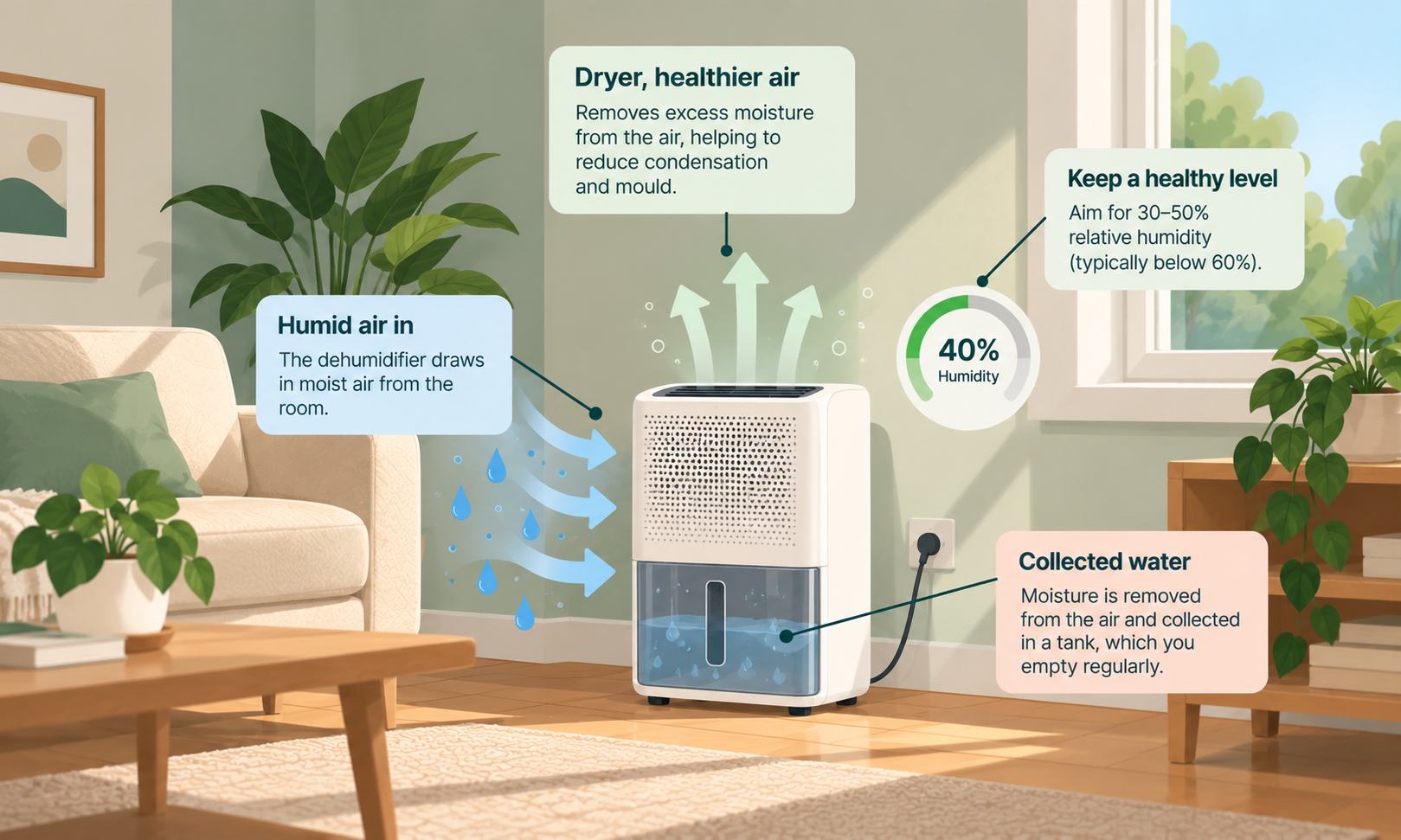
A dehumidifier removes water vapour from indoor air.
It can be useful when indoor humidity remains high despite appropriate ventilation, or when outdoor conditions make ventilation ineffective.
Common situations include:
Humid climates.
Basements with elevated humidity.
Rooms used for indoor laundry drying.
Homes with recurring condensation linked to excessive humidity.
But a dehumidifier doesn't fix a leaking roof, failed plumbing or defective drainage.
It also doesn't supply fresh outdoor air.
Choose one for the room and conditions
Dehumidifiers differ in capacity, operating temperature range, energy use and noise.
Consider the size and temperature of the space, the amount of moisture present and whether continuous drainage is practical.
A unit suitable for a warm living room may perform differently in a cold basement.
Use a humidity target
A humidistat can help the appliance maintain a chosen relative humidity rather than running continuously.
Avoid making indoor air excessively dry, which can cause discomfort.
Clean the tank, filters and drainage system according to the manufacturer's instructions.
Tip: If the dehumidifier collects unusually large amounts of water every day and the problem never improves, investigate whether an ongoing leak or other moisture source is replenishing the water.
10. Heat the home consistently where practical
Cold indoor surfaces are more likely to develop condensation when they come into contact with humid air.
Maintaining suitable room temperatures can help reduce this risk.
This doesn't mean every room must be heated constantly to a high temperature.
The goal is to avoid prolonged cold, damp conditions while managing indoor humidity.
In colder climates, the combination of appropriate heating, insulation and ventilation is often more effective than relying on any one of them.
Be especially careful with rarely used bedrooms, storage rooms and other areas that remain cooler than the rest of the home.
Check those rooms periodically for condensation and mould.
Avoid using unvented combustion heaters inappropriately. Some release water vapour and dangerous combustion pollutants into indoor air.
Follow local safety requirements and appliance instructions, including suitable carbon monoxide protection where relevant.
11. Dry laundry without creating a moisture problem
Drying clothes indoors releases water into the room as the clothes dry.
In a well-ventilated home this may be manageable.
In a small or poorly ventilated home, it can contribute significantly to condensation.
When possible:
Dry laundry outdoors in suitable weather.
Use a properly vented or maintained tumble dryer.
Choose a room with adequate ventilation if drying indoors.
Use suitable dehumidification when necessary.
Avoid placing wet laundry directly against cold walls.
Keep drying racks away from heaters and other hazards.
Don't block ventilation openings or overload a small room with damp clothes.
If you frequently dry laundry indoors, check humidity readings before and during drying to see how much the activity affects your home.
12. Be careful when improving insulation and airtightness
Energy-efficient homes can be comfortable and less expensive to heat or cool.
But airtightness and insulation need to work alongside suitable ventilation and moisture control.
A renovation that seals gaps and replaces windows may reduce uncontrolled air leakage.
That's often beneficial for energy use.
However, the home still needs enough fresh air and appropriate removal of moisture and pollutants.
In some buildings, old ventilation arrangements may no longer be adequate after major upgrades.
Don't seal over a damp problem
Before adding insulation or impermeable finishes, investigate active water damage.
A wall that relies on drying through a particular surface may behave differently after a new coating or insulation system is installed.
The correct materials and methods depend on construction type and climate.
Historic buildings can require particular care because their moisture behaviour may differ from modern construction.
Ask a qualified professional familiar with the building type to assess significant changes.
13. What to do if damp keeps coming back
Recurring dampness is a sign that the original diagnosis or repair may be incomplete.
Instead of repeating the same treatment, investigate systematically.
Track the pattern
Record:
Which room is affected.
Exactly where the moisture appears.
Whether it worsens after rain.
Whether it happens mainly in cold weather.
Humidity and temperature readings.
What cleaning or repairs have already been attempted.
Whether the problem improves with ventilation or heating.
Take dated photographs.
A clear history helps a professional understand what has been happening.
Get the right specialist
Different problems need different expertise.
A plumber may investigate concealed pipe leaks.
A roofer may examine failed flashing or roof coverings.
A qualified building surveyor, engineer or building-envelope specialist may assess structural moisture and water penetration.
A ventilation specialist may investigate inadequate airflow or system performance.
For substantial mould contamination, a qualified remediation company may be appropriate.
Avoid assuming that every damp problem should be handled by a contractor selling one particular treatment.
14. What renters should do about damp and mould
Renters may be able to improve ventilation, reduce indoor moisture and clean minor surface condensation.
But some problems require repairs to the building itself.
If damp appears to be caused by leaks, defective ventilation, drainage or building defects, notify the landlord or property manager promptly.
Use written communication and keep records.
Include:
The location of the affected area.
When the problem first appeared.
Photographs of the damage.
Whether there is visible mould or water intrusion.
Any immediate safety concerns.
What steps have already been taken.
Housing standards and landlord responsibilities differ by country and locality.
Don't assume that a renter is responsible for structural damp simply because they occupy the home.
Likewise, landlords should investigate reported moisture problems rather than automatically attributing all mould to tenant behaviour.
If serious issues remain unresolved, contact the appropriate local housing authority or tenant advice organization.
15. A simple seven-day damp investigation
You can learn a lot about the problem before paying for unnecessary treatments.
Day 1: Record what you see
Photograph damp patches, condensation and mould.
Note the affected rooms and surfaces.
Check for obvious plumbing leaks or signs of active water entry.
Day 2: Measure humidity
Use a hygrometer to record humidity and temperature in the affected room.
Take readings in the morning and evening.
Day 3: Inspect ventilation
Check that existing extractor fans and ventilation openings are functioning and unobstructed.
Use them correctly when cooking or bathing.
Day 4: Investigate cold surfaces
Inspect window frames, exterior corners and areas behind large furniture.
Move furniture where practical to permit inspection and airflow.
Day 5: Check exterior drainage
From safe, accessible areas, look for overflowing gutters, blocked drains and water collecting against external walls.
Day 6: Review the pattern
Compare humidity readings and photographs.
Does the problem follow rainfall, showers, laundry drying or cold nights?
Day 7: Choose the next action
If the cause is clearly excess indoor humidity, improve moisture management and monitor the results.
If you suspect leaks, hidden water damage or significant mould growth, arrange professional assessment rather than waiting for the problem to worsen.
Important: Don't delay emergency repairs or significant water-damage cleanup to complete this seven-day process. Active flooding, electrical hazards and serious leaks require immediate action.
Common mistakes to avoid
Painting over mould. It hides visible growth without correcting the moisture source.
Assuming all damp is condensation. Leaks and drainage defects need different repairs.
Using a dehumidifier to compensate for a roof leak. Removing moisture from the air won't stop water entering the building.
Blocking ventilation openings. A warmer room isn't necessarily a healthier room if moisture and pollutants accumulate.
Pushing furniture against cold walls. Restricted airflow can encourage hidden condensation.
Ignoring small plumbing leaks. Slow leaks can damage materials for months before becoming obvious.
Installing insulation over existing damp. Moisture may become trapped or harder to detect.
Using bleach as the only solution. Cleaning products don't replace moisture control.
Assuming black mould can be identified by colour. Appearance alone doesn't establish the type or risk.
Buying expensive treatments without a diagnosis. The wrong repair may waste money and leave the problem unresolved.
Waiting too long after water damage. Wet materials need prompt attention to reduce the chance of mould growth.
Ignoring returning stains. A recurring stain is evidence that further investigation is needed.
Frequently asked questions
Why does my bedroom feel damp every morning?
Overnight moisture from breathing, combined with limited ventilation and cold surfaces, can contribute to condensation. However, persistent dampness may also have other causes, including leaks.
Is condensation on windows normal?
Occasional condensation can occur, especially on cold mornings. Persistent water accumulation, damaged window frames or nearby mould suggests that moisture management needs attention.
What is a good humidity level for a home?
Around 30 to 50 percent relative humidity is a common target. Keeping humidity below 60 percent where practical helps reduce conditions favourable to mould, but surface temperature also matters.
Does opening windows prevent mould?
Ventilation can reduce excess indoor humidity when outdoor conditions are suitable. However, opening windows will not fix roof leaks, plumbing problems or other sources of water intrusion.
Can mould grow behind furniture?
Yes. Large furniture placed against cold walls can restrict air movement and create conditions where condensation persists.
Will a dehumidifier get rid of damp permanently?
It can help manage excess airborne moisture, but it will not permanently solve problems caused by water leaks, drainage defects or other building faults.
Is black mould always dangerous?
Mould can affect health, but its colour alone doesn't establish the type or level of risk. Visible mould and persistent dampness should be addressed regardless of colour.
Can I paint over a damp wall?
Not until the underlying moisture problem has been corrected, affected materials are sufficiently dry and any mould or damaged finishes have been properly addressed.
Does heating prevent damp?
Appropriate heating can raise surface temperatures and reduce condensation risk. It works best alongside moisture control, insulation and ventilation.
How do I know if damp comes from the roof?
Moisture that appears near ceilings or upper walls and worsens after rainfall can suggest roof or flashing problems. A qualified inspection may be necessary to confirm the source.
Can rising damp be mistaken for condensation?
Yes. Low-level moisture can have several causes. A professional diagnosis should distinguish groundwater movement from surface water, condensation and plumbing leaks.
Should I buy a mould test kit?
If mould is already visible, confirming that some mould is present may add little practical value. Finding and correcting moisture sources is usually the priority. Specialized testing may be useful in particular investigations when directed by a qualified professional.
How quickly can mould grow after a leak?
Mould can begin developing on suitable wet materials within a relatively short period. The EPA recommends cleaning and drying wet building materials within 24 to 48 hours when possible to reduce mould growth.
The quick damp and mould checklist
Identify whether moisture is likely coming from condensation, leaks or the ground.
Photograph affected areas and note when the problem appears.
Measure indoor relative humidity.
Investigate recurring window condensation.
Check bathroom and kitchen ventilation.
Use extractor fans correctly.
Keep designed ventilation openings unobstructed.
Avoid prolonged indoor laundry drying without moisture control.
Inspect behind large furniture on cold walls.
Check roofs, gutters and external drainage where safely accessible.
Investigate leaking pipes and appliances.
Keep indoor surfaces adequately warm where practical.
Consider suitable insulation and ventilation improvements.
Use a dehumidifier when excess airborne humidity is the problem.
Clean limited surface mould using appropriate precautions.
Get professional help for extensive, hidden or recurring mould.
Dry water-damaged materials promptly.
Avoid painting over unresolved damp.
Keep a record of repairs and recurring symptoms.
Confirm the moisture source is fixed before spending money on cosmetic repairs.
Sources and further reading
Damp problems vary by climate, building age, construction type and ventilation system. Use these resources as a starting point, and obtain building-specific advice where necessary.
World Health Organization: WHO guidelines for indoor air quality: dampness and mould — evidence on indoor dampness, mould and respiratory health.
US Environmental Protection Agency: A brief guide to mold, moisture and your home — moisture prevention, cleanup and indoor humidity.
Energy Saving Trust: How to get rid of damp — condensation, damp sources and prevention.
Energy Saving Trust: How to improve your home's ventilation — improving airflow and indoor air quality.
Your local building authority or qualified building professional — construction-specific moisture control, drainage, insulation and repair requirements.
Note: This article provides general information about household damp, condensation and mould, not medical, engineering or building-survey advice. Moisture problems can have multiple causes, and inappropriate repairs may make them worse. For substantial water damage, persistent mould, structural deterioration or suspected health effects, seek advice from appropriately qualified professionals.
Keep reading

First-time home buyer checklist: 12 things to do before an offer
A US first-time buyer checklist: 12 things to settle before you make an offer, from budget and credit to pre-approval, inspections and closing costs.
BuyingWhat to look for on a house viewing: a 15-minute checklist
A 15-minute viewing-day routine for US home buyers: what to check, what to ask the seller, and the red flags that staging can hide.

How much down payment do you really need to buy a house in the US?
You don't need 20 percent down. Compare conventional, FHA, VA and USDA down payments, what each costs, and how to choose the right one.