
Why your electricity bill is so high, and how to lower it.
Discover why your electricity bill is high, which appliances use the most power, and practical ways to reduce energy costs at home.
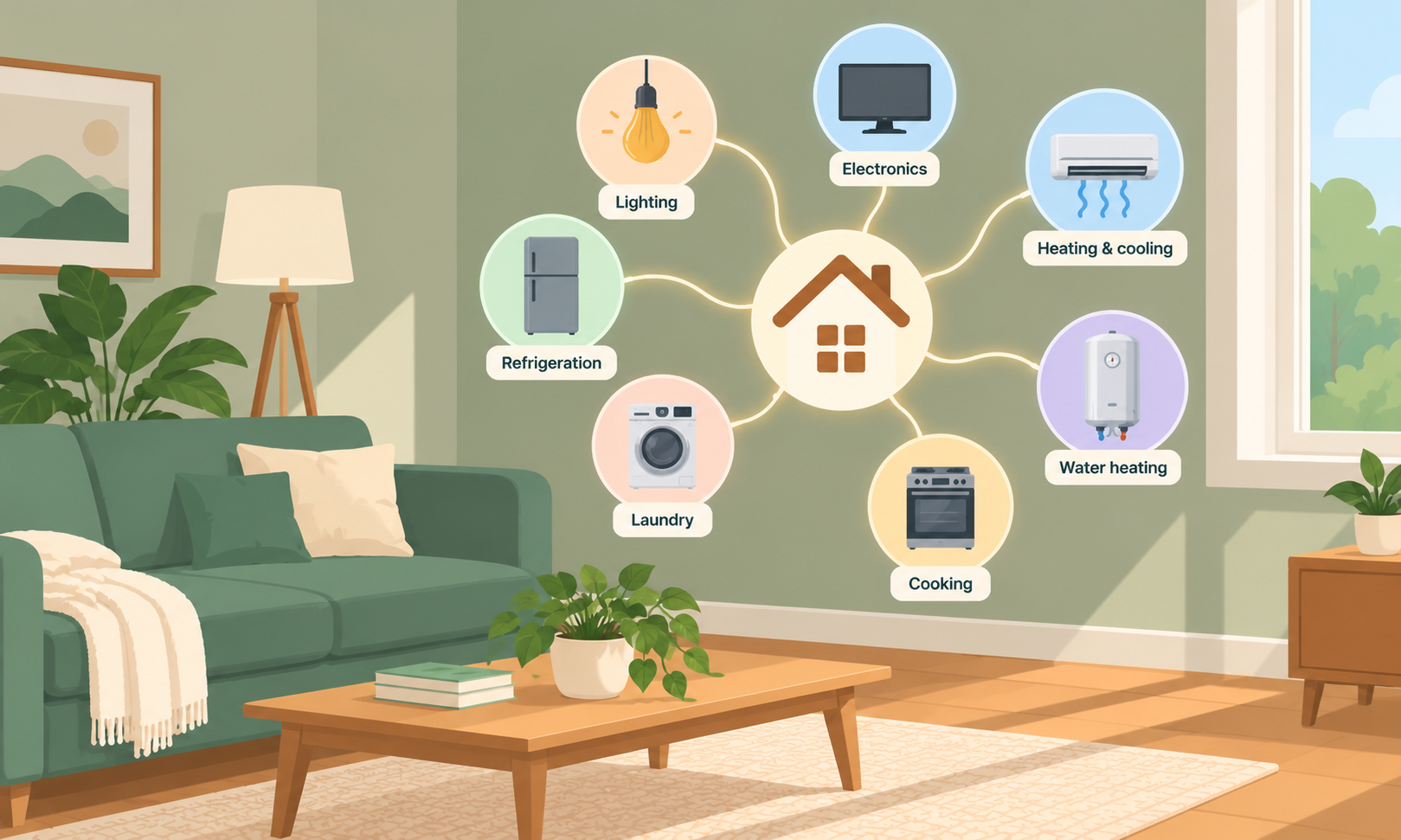
You switch off lights, unplug phone chargers and try to use less electricity. Then the next bill arrives, and it's barely changed.
The problem is that not all electricity use is equal.
A small appliance running continuously can consume more electricity than a powerful appliance used for a few minutes. An inefficient water heater can quietly add to the bill every day. Air conditioning, electric heating and old appliances can use far more electricity than the lights you're carefully switching off.
Sometimes the problem isn't your electricity use at all. The supplier may have increased its rates, an estimated reading may have been corrected, or your bill may cover more days than usual.
Before buying smart plugs, replacing appliances or changing your daily routine, find out where the money is actually going.
This guide explains how to read your electricity bill, identify the appliances that use the most power and decide which energy-saving changes are worth making.
Key rule: Measure first, improve second. The biggest electricity savings usually come from understanding your largest loads, not obsessing over every small device.
Start with the bill, not the appliances
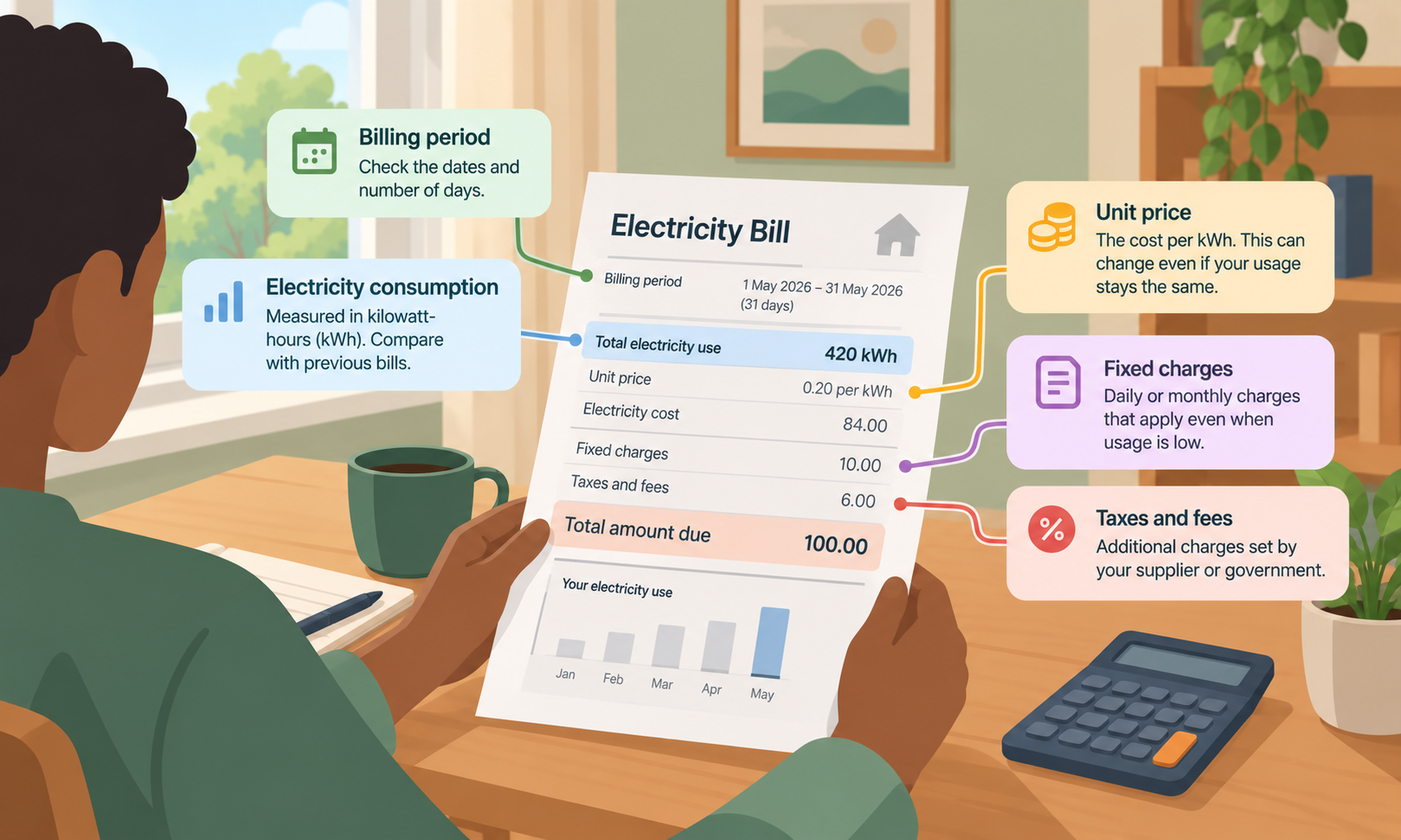
A high electricity bill can mean two different things.
You're using more electricity than before, or you're paying more for each unit of electricity.
Those problems need different solutions.
Start by comparing your latest bill with an earlier one.
Look for:
Electricity consumption: Usually measured in kilowatt-hours (kWh).
Price per unit: The amount charged for each kWh.
Fixed charges: Daily, monthly or other charges that may apply even when usage is low.
Billing period: The number of days included.
Taxes and additional fees: Charges determined by the supplier or local regulations.
Meter readings: Whether the bill uses actual measurements or estimates.
Don't compare only the final amounts.
If your previous bill covered 28 days and the new bill covers 35, the total may be higher simply because it includes another week.
Calculate your daily electricity use
Suppose your household used 420 kWh over 30 days.
Average daily consumption is:
420 ÷ 30 = 14 kWh per day
Now suppose the previous bill recorded 360 kWh over 30 days.
That was:
360 ÷ 30 = 12 kWh per day
Your average daily consumption has increased by about 16.7 percent.
That's a meaningful change worth investigating.
If consumption stayed the same but your bill increased, check the electricity tariff, fixed charges and taxes.
Tip: Compare the same season across different years where possible. Electricity use in a cold winter or hot summer may be very different from a mild month.
1. Understand watts and kilowatt-hours
Before identifying expensive appliances, understand the difference between power and energy.
Watts (W) describe how quickly an appliance uses electrical energy.
Kilowatt-hours (kWh) measure the total electricity consumed over time.
One kilowatt equals 1,000 watts.
An appliance rated at 1,000 watts running continuously for one hour consumes approximately 1 kWh.
The basic calculation is:
Electricity used (kWh) = Power (W) × Hours used ÷ 1,000
For example, a 2,000-watt electric heater running for three hours consumes:
2,000 × 3 ÷ 1,000 = 6 kWh
If electricity costs 0.20 per kWh in your local currency, that would cost:
6 × 0.20 = 1.20
These numbers assume the appliance actually draws 2,000 watts throughout those three hours.
Many appliances cycle on and off or vary their power, so their actual consumption may be lower than a simple nameplate calculation suggests.
Why usage time matters
A 2,000-watt kettle used for six minutes consumes approximately 0.2 kWh.
A 100-watt device running continuously for 24 hours consumes 2.4 kWh.
The lower-powered device uses twelve times as much electricity in that example because it operates for much longer.
This is why wattage alone doesn't tell you which appliances are expensive to run.
2. Find the appliances using the most electricity
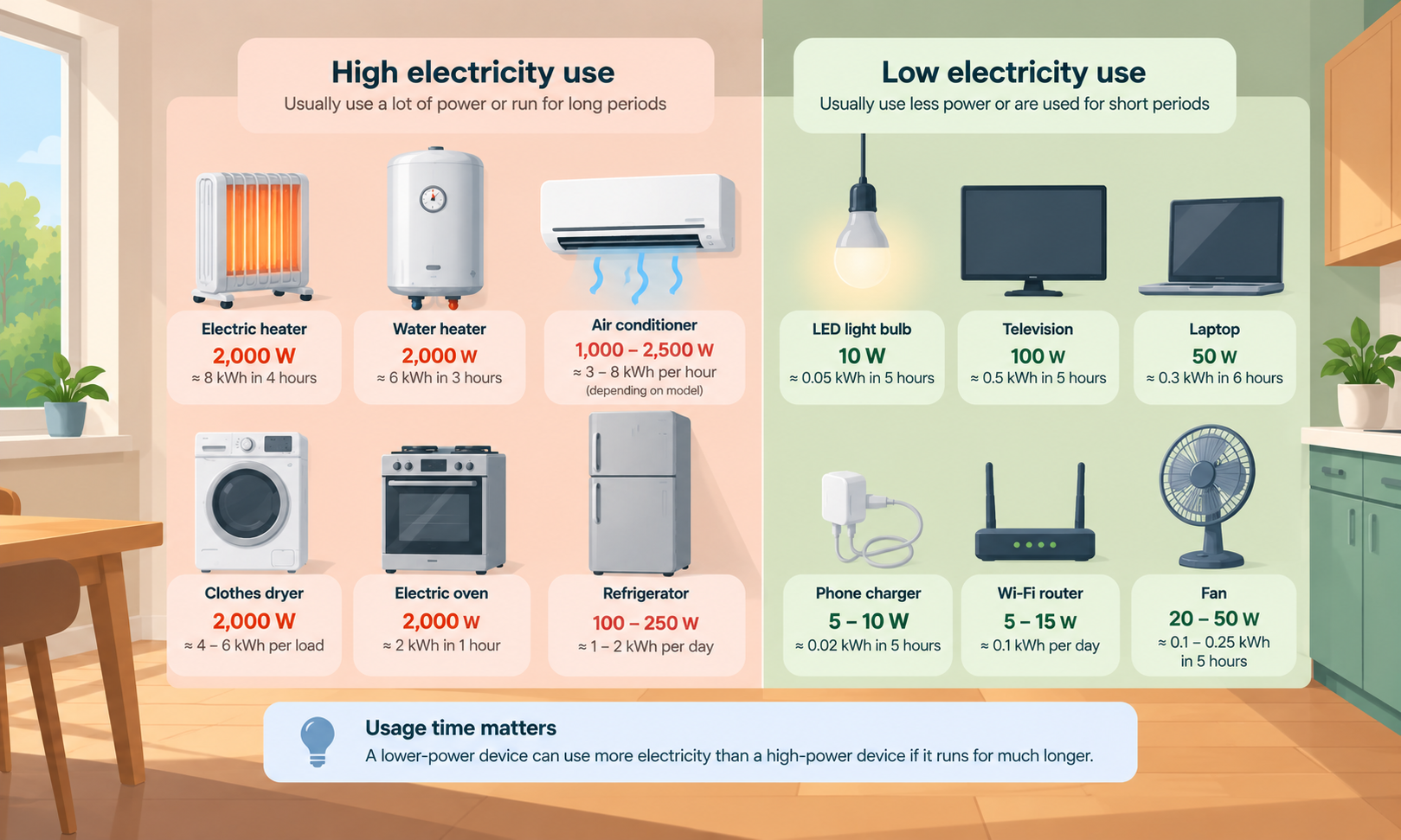
The biggest electricity users depend on your climate, home and equipment.
In homes with electric heating, cooling or hot water, those systems can account for a substantial share of consumption.
Other important users may include:
Electric space heaters.
Air conditioners and heat pumps.
Electric water heaters.
Clothes dryers.
Electric ovens and cooktops.
Refrigerators and freezers.
Washing machines and dishwashers.
Dehumidifiers.
Pool pumps or other continuously operating equipment.
The amount of electricity an appliance consumes depends on its power, efficiency, operating conditions and usage time.
An illustrative comparison
Assume the following appliances are used for the stated durations.
AppliancePowerUsageEnergyElectric heater2,000 W4 hours8 kWhElectric oven2,000 W1 hour2 kWhTelevision100 W5 hours0.5 kWhLED bulb10 W5 hours0.05 kWhLaptop50 W6 hours0.3 kWh
These are simplified examples assuming constant power draw.
Real ovens and heaters may cycle. Laptop consumption changes with workload and charging. Refrigerators, heat pumps and variable-speed air conditioners require more careful estimates.
Still, the comparison reveals something useful.
Switching off a 10-watt light for one hour saves 0.01 kWh.
Reducing the operation of a 2,000-watt heater by one hour, assuming constant power, saves 2 kWh.
That is 200 times as much electricity.
Both actions reduce consumption, but their impact is very different.
3. Heating and cooling may be your largest expense
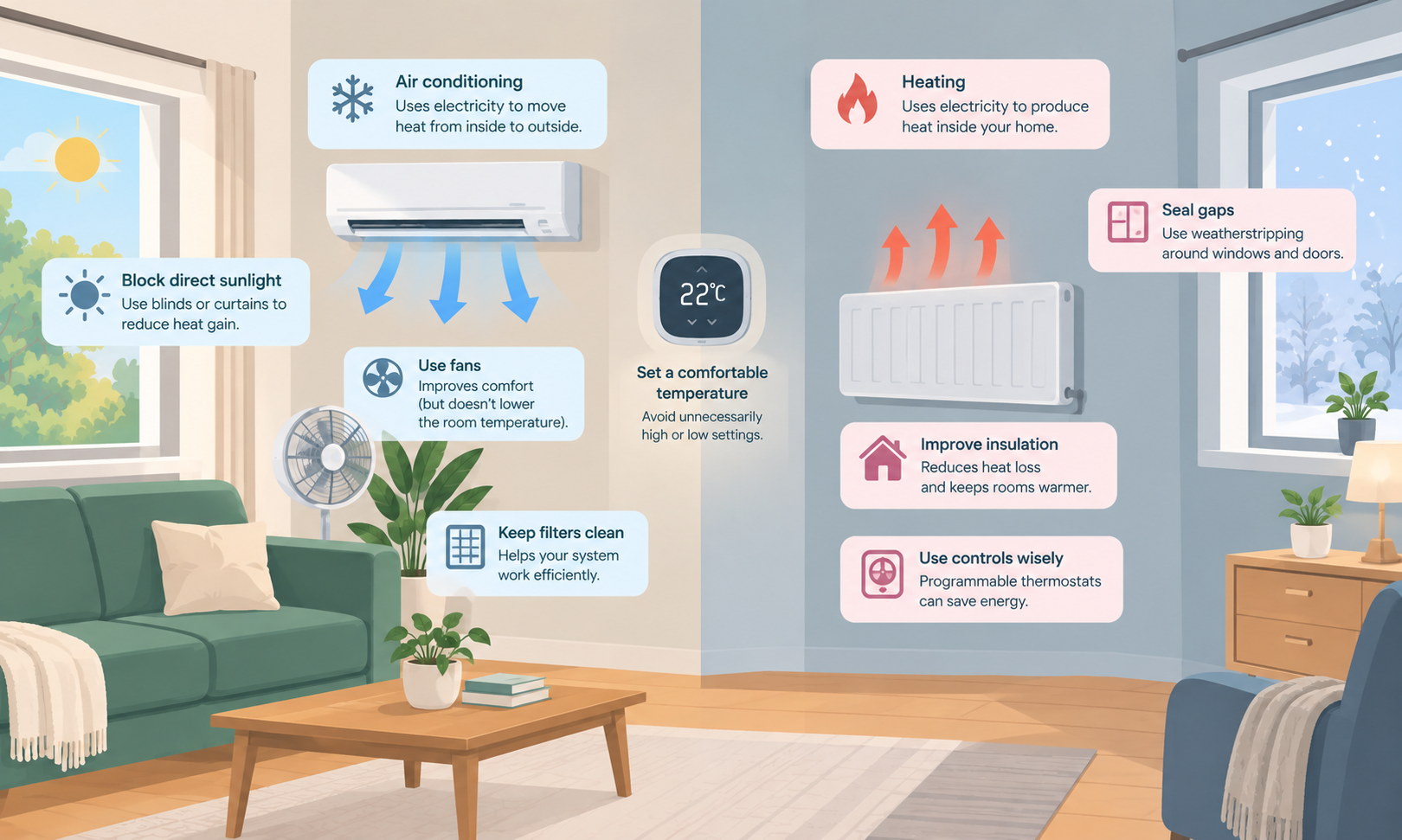
Heating and air conditioning can use substantial amounts of electricity because they change the temperature of an entire room or building.
The harder the system works, the more electricity it may consume.
Several factors affect demand:
Outdoor temperature.
Insulation quality.
Air leakage.
Window area and sunlight.
Thermostat settings.
Equipment efficiency.
Room size.
Hours of operation.
Cooling a home
Air conditioning uses electricity to move heat from inside the building to the outside.
The greater the cooling demand, the harder the system may need to work.
You can often reduce cooling demand by:
Keeping blinds or curtains closed against strong direct sunlight.
Using suitable exterior shading where available.
Setting the thermostat to a comfortable rather than unnecessarily cold temperature.
Cleaning or replacing filters according to the manufacturer's instructions.
Keeping outdoor units free of obstructions.
Using fans to improve comfort when appropriate.
Closing windows when outdoor air is hotter or more humid than indoor air.
Fans can make people feel cooler by moving air, but they don't usually reduce the actual room temperature.
They're most useful when people are present.
Heating a home
In colder climates, electric heating may be a major contributor to winter bills.
Consider:
Sealing appropriate gaps around windows and doors.
Improving insulation where practical.
Avoiding unnecessarily high thermostat settings.
Heating occupied spaces appropriately.
Using programmable controls sensibly.
Maintaining heating equipment.
Choosing efficient heating technology when replacement becomes necessary.
Heat pumps versus resistance heaters
A resistance heater converts electricity into heat within the room.
A heat pump transfers heat from another location, often delivering more heat energy than the electrical energy it consumes.
That makes heat pumps substantially more efficient under suitable conditions.
However, actual performance depends on outdoor temperature, system design, maintenance and installation quality.
Don't replace functioning equipment without calculating the likely costs and benefits.
Tip: Before purchasing a more efficient heating or cooling system, investigate your home's insulation and air leakage. Reducing heating and cooling demand can change the equipment capacity required.
4. Your water heater may be costing more than you think
Water heating can be a significant household energy expense, especially when electricity is used to heat and store hot water.
Electric storage water heaters may use electricity even when nobody is showering because the stored water gradually loses heat.
Consumption depends on:
Tank insulation.
Water temperature settings.
Shower duration.
Number of occupants.
Hot-water pipe losses.
Appliance efficiency.
Whether hot water is leaking.
Look for avoidable hot-water use
Simple improvements include:
Fixing leaking hot-water taps.
Repairing plumbing leaks.
Using efficient showerheads where appropriate.
Reducing unnecessarily long showers.
Insulating suitable hot-water pipes.
Maintaining the heater according to its instructions.
Don't reduce water-heater temperatures arbitrarily.
Stored hot-water systems must be configured to control risks such as scalding and Legionella bacterial growth, following manufacturer instructions and local standards.
Should you turn the heater off?
That depends on the system.
Some water heaters are designed for continuous operation, while others have schedules or vacation modes.
Turning equipment on and off without understanding how it operates may provide little benefit or create inconvenience and safety issues.
Check the manufacturer's guidance before changing its controls.
5. Refrigerators and freezers run all day
Unlike a kettle or toaster, a refrigerator remains connected to electricity around the clock.
Its compressor doesn't normally run continuously, but it switches on whenever cooling is needed.
An inefficient or malfunctioning refrigerator can therefore contribute significantly to household consumption.
Check the door seals
Damaged or poorly sealing refrigerator doors allow warm air to enter.
The cooling system then needs to work harder.
Inspect the seals for gaps, damage and dirt.
Leave room for ventilation
Refrigerators need suitable airflow around their heat-rejection components.
Follow the manufacturer's clearance recommendations, especially when placing an appliance inside cabinetry.
Avoid unnecessary temperature extremes
Setting a refrigerator far colder than necessary can increase energy consumption.
Follow food-safety guidance and manufacturer recommendations for safe temperatures.
Clean and maintain the appliance
Dust accumulation on accessible condenser coils can affect performance on some designs.
Follow the appliance manual before cleaning, and disconnect power where instructed.
An old refrigerator isn't automatically worth replacing.
Compare its measured or estimated annual electricity consumption with a new model, then calculate whether the saving justifies the purchase price.
6. Standby electricity adds up
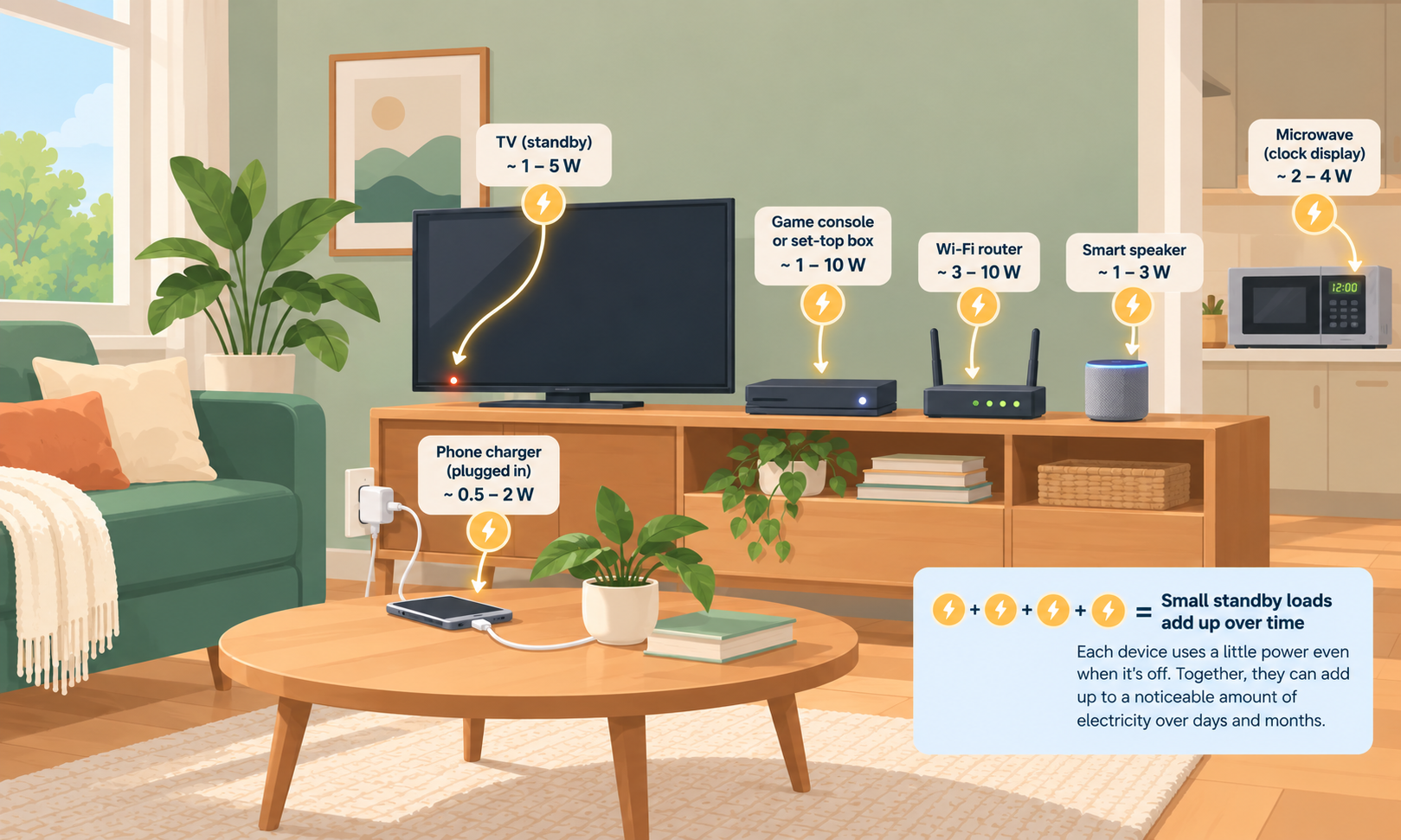
Some appliances consume electricity even when they appear to be switched off.
This is called standby power.
Examples include:
Televisions awaiting a remote-control signal.
Game consoles in standby.
Set-top boxes.
Smart speakers.
Desktop computers in sleep mode.
Printers.
Appliances with clocks or displays.
Certain chargers and connected accessories.
The power draw of an individual device may be small.
But continuous use adds up over a year.
For example, a device consuming 5 watts continuously uses:
5 × 24 × 365 ÷ 1,000 = 43.8 kWh per year
If you have several such devices, the combined consumption may become meaningful.
What should stay connected?
Don't indiscriminately disconnect everything.
Refrigerators, freezers, medical equipment, alarm systems and certain heating controls may require continuous power.
Some electronics also need standby periods for updates or scheduled functions.
Use switched power strips or appropriate smart plugs for devices that can safely be disconnected.
And don't assume every phone charger is a major electricity user. Modern chargers often consume very little power when not charging anything.
Measure or check specifications before prioritizing them.
7. Laundry and drying habits affect energy use
Washing machines, dryers and ironing equipment can contribute to electricity bills.
The biggest energy use in washing often comes from heating water.
Where suitable for the clothes, detergent and hygiene requirements, washing at lower temperatures can reduce energy consumption.
Always follow fabric-care instructions.
Drying clothes
Electric tumble dryers use energy to remove moisture from laundry.
Line-drying or air-drying can reduce electricity use when conditions permit.
However, drying laundry indoors can increase humidity and contribute to condensation and mould if ventilation is inadequate.
If you use a tumble dryer:
Clean lint filters as instructed.
Avoid unnecessary drying cycles.
Use sensor-drying features where available.
Don't overload the appliance.
Maintain exhaust ducts or condensate systems as appropriate.
Never leave a dryer operating unattended if the manufacturer's instructions or local fire-safety guidance advise against it.
8. Lighting matters, but it may not be your biggest problem
Lighting is an easy area to improve.
Modern LED bulbs generally use much less electricity than older incandescent lamps for a comparable amount of light.
Replacing frequently used inefficient bulbs can provide worthwhile savings.
Choose bulbs based on light output
Brightness is measured in lumens.
Wattage describes power consumption.
A higher wattage doesn't necessarily mean a better bulb.
Look for suitable brightness, efficiency, color temperature and compatibility with existing fixtures or dimmers.
Use lighting where it's needed
Other practical habits include:
Turning off lights in unused rooms.
Using task lighting rather than illuminating an entire room unnecessarily.
Making better use of natural light.
Installing suitable timers or sensors where they solve a real problem.
Don't spend large amounts on automation without estimating the likely savings.
A smart lighting system may improve convenience, but it won't necessarily pay for itself through reduced electricity consumption.
9. Check your electricity tariff
Sometimes the easiest way to lower a bill is to reduce the price you pay rather than the electricity you consume.
Depending on your country and supplier, electricity plans may differ in:
Unit rates.
Fixed charges.
Peak and off-peak prices.
Contract periods.
Minimum charges.
Discounts or payment conditions.
Renewable energy options.
Time-of-use pricing
Some electricity tariffs charge different prices depending on the time of day.
Electricity may be cheaper during off-peak periods and more expensive during peak demand.
If your plan uses time-of-use pricing, moving suitable consumption to cheaper periods may lower costs.
For example, you may be able to schedule a dishwasher, electric vehicle charging or other appropriate appliance use when the tariff is lower.
But this doesn't help if you pay a flat rate throughout the day.
It may even cost more if your off-peak plan has higher charges at other times and your usage pattern doesn't fit.
Compare the full tariff, not just an advertised discount.
Check fixed charges
A tariff with a low unit price may have a higher daily or monthly fixed charge.
For households using little electricity, fixed charges can make a substantial difference to the total bill.
10. Don't ignore estimated readings or billing errors
An unexpected electricity bill isn't always evidence of excessive consumption.
It may reflect a billing correction.
Some suppliers estimate usage when actual meter readings aren't available.
When a later reading arrives, the bill may be adjusted to account for the difference.
What to check
Compare the reading on your bill with the meter reading, where you can safely access the meter.
Check that:
The meter number matches your account.
The readings cover the correct dates.
The reading type is identified.
Previous payments or credits were applied.
The tariff matches your agreement.
The bill doesn't duplicate a previous period.
If something appears incorrect, contact the supplier and provide the relevant records.
What if the meter is faulty?
Electricity meters can develop faults, but unusually high bills often have other explanations.
Ask the supplier about its meter-checking or testing procedure.
Don't open meter covers, tamper with seals or attempt electrical testing yourself.
11. Use a smart meter or energy monitor
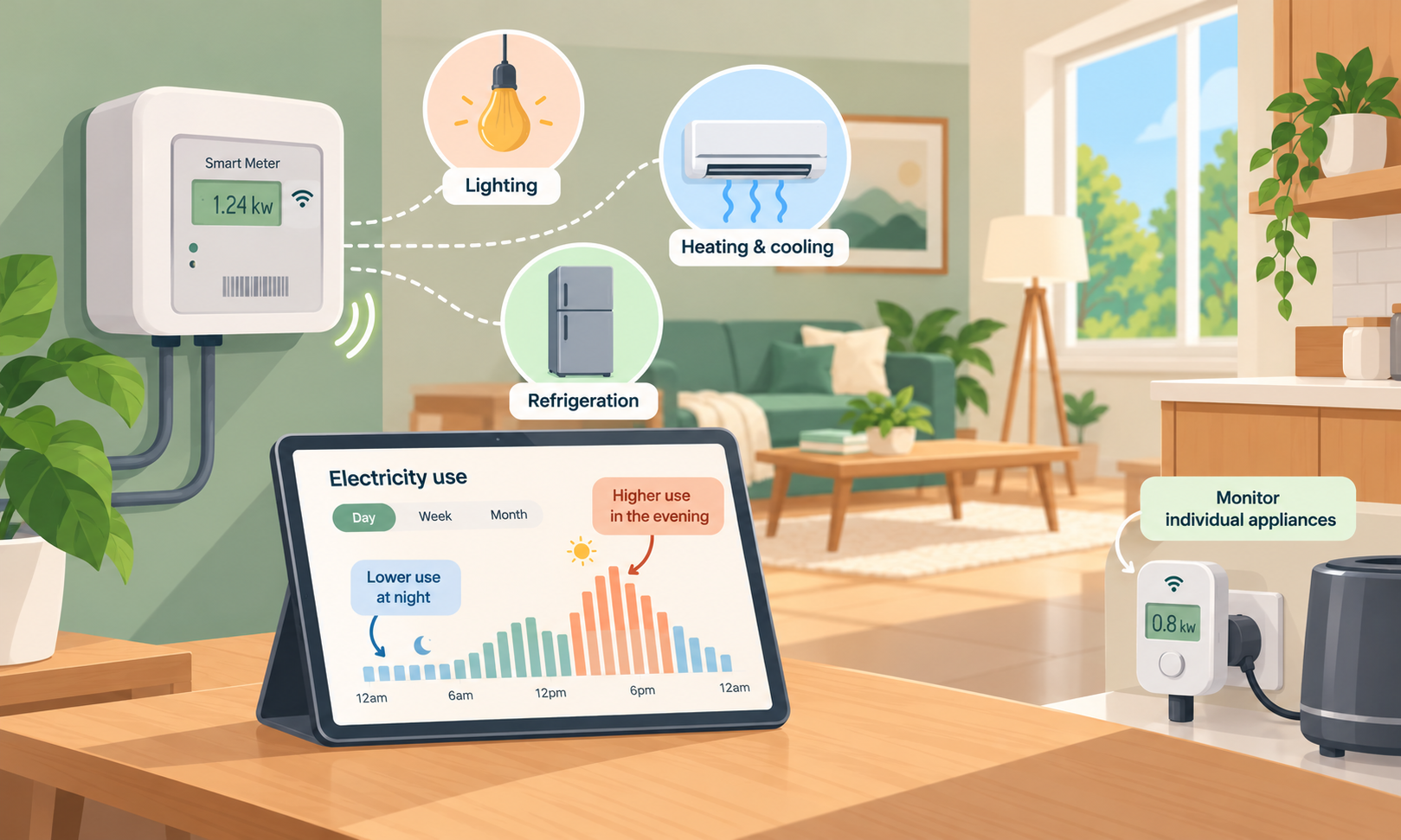
A smart meter can provide more frequent electricity-usage information than a traditional manually read meter.
Depending on the system, you may be able to review daily, hourly or shorter-period consumption.
This can help reveal patterns.
For example:
Does consumption rise sharply when the air conditioner runs?
Is the household using substantial electricity overnight?
Did consumption increase after a new appliance was installed?
Does usage remain high when nobody is home?
A smart meter doesn't automatically save electricity
It measures or reports consumption.
The savings come from using that information to identify and change wasteful usage.
Smart plugs and plug-in energy monitors
Some plug-in devices can measure the electricity consumed by individual appliances.
They may be useful for televisions, computers and other compatible plug-in equipment.
Choose equipment rated for the appliance and electrical system.
Don't use ordinary smart plugs for high-power heaters, large appliances or equipment beyond their ratings.
Never connect a whole-home meter or work inside an electrical panel yourself unless you're properly qualified and authorized.
12. Look for electricity use when nobody is home
One revealing question is how much electricity your home consumes when you're asleep or away.
Some background consumption is normal.
Refrigerators, network equipment, heating controls and other essential systems may continue operating.
But unusually high background use may indicate:
Equipment that runs continuously.
A malfunctioning appliance.
Unnecessary electric heating.
Water heating operating unexpectedly.
A pump or fan running when it shouldn't.
Excessive standby consumption.
If your smart meter supports detailed usage history, compare periods when household activity is low.
You can also use an appropriate plug-in energy meter to investigate individual compatible appliances.
Don't switch off critical systems or interfere with the electrical installation to perform experiments.
If unexplained consumption remains high, seek help from the supplier or a qualified electrician.
13. Calculate whether an energy-saving purchase is worthwhile
A new appliance might use less electricity, but that doesn't mean replacing the existing one immediately is financially sensible.
Consider a refrigerator that costs 700 in your local currency.
Suppose it saves 100 kWh per year compared with your existing refrigerator.
At an electricity price of 0.25 per kWh, the annual saving is:
100 × 0.25 = 25 per year
Ignoring changes in rates and other costs, simple payback would be:
700 ÷ 25 = 28 years
That's unlikely to justify replacing a functioning refrigerator solely for electricity savings.
However, if the old unit is failing, requires expensive repairs or consumes unusually high amounts of power, replacement may make sense for additional reasons.
Use simple payback carefully
Simple payback = Upfront cost ÷ Annual saving
This calculation is useful for a first comparison.
But it doesn't account for financing, future electricity prices, maintenance, equipment lifetime or the value of improved comfort.
For expensive upgrades, compare the full lifetime cost rather than relying only on the payback period.
14. Don't overlook the building itself
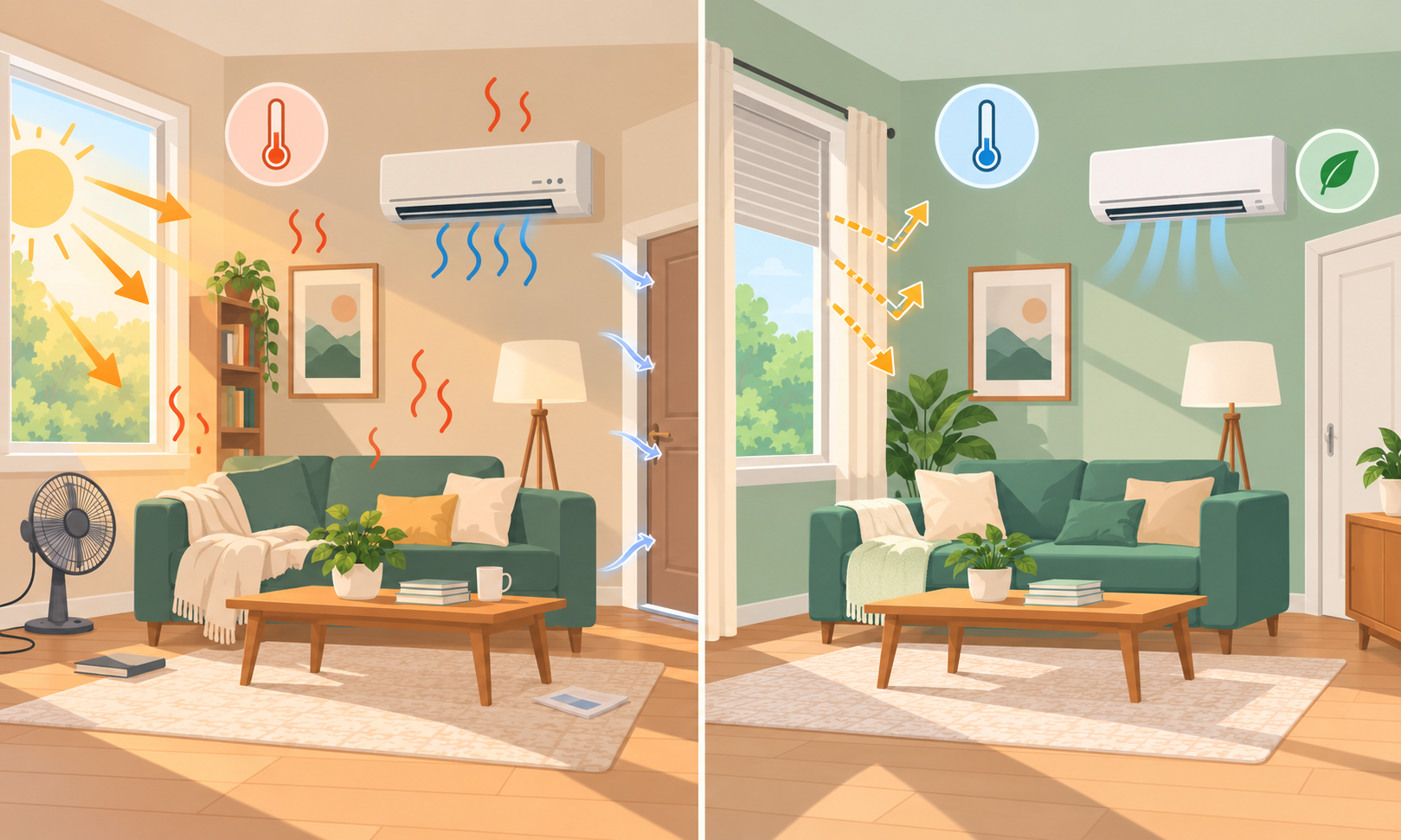
Electricity use isn't determined only by appliances.
The building can force heating and cooling systems to work harder than necessary.
Common problems include:
Poor attic or roof insulation.
Air leakage around windows and doors.
Inadequate wall insulation.
Excessive solar heat gain.
Unshaded windows.
Poorly sealed ductwork.
Moisture problems affecting insulation.
Inefficient heating and cooling distribution.
Some improvements are inexpensive.
Weatherstripping appropriate doors or closing blinds during strong sunlight may reduce heating or cooling demand.
Other upgrades require professional assessment.
Avoid sealing the house without planning ventilation
Reducing uncontrolled air leakage can improve energy efficiency.
But homes still need adequate ventilation and moisture control.
Sealing a building without considering airflow may worsen humidity or indoor air-quality problems.
This is especially important in homes that already experience condensation and mould.
15. What if you're renting?
Renters often have less control over insulation, installed heating systems and major appliances.
But you can still investigate electricity use.
Start with:
Checking whether the bill reflects your own meter.
Comparing monthly or daily kWh consumption.
Understanding your tariff.
Using provided heating and cooling equipment efficiently.
Replacing inefficient bulbs where permitted.
Measuring compatible plug-in appliances.
Reporting malfunctioning equipment.
Using curtains, shades and ventilation appropriately.
If a built-in appliance is malfunctioning or using unusual amounts of electricity, report it to the landlord or property manager.
For major improvements, seek permission before changing fixtures or equipment.
A tenant shouldn't attempt unauthorized electrical work to reduce consumption.
A seven-day electricity investigation
You don't need to change your entire lifestyle to understand your bill.
Spend one week identifying the biggest sources of consumption.
Day 1: Read the bill
Record total kWh, billing days, unit price and fixed charges.
Compare average daily consumption with an earlier period.
Day 2: Inspect your largest appliances
List heating, cooling, hot water, refrigeration and laundry equipment.
Note their approximate wattage, operating time and age.
Day 3: Observe background consumption
Use a smart meter or suitable monitoring method to examine overnight or low-activity consumption.
Look for unexpected continuous loads.
Day 4: Examine heating and cooling
Review thermostat settings, filters, sunlight and drafts.
Make safe, practical adjustments that don't compromise comfort or health.
Day 5: Review hot water and laundry
Check for leaks, unnecessary hot-water use and inefficient drying habits.
Day 6: Review the tariff
Confirm whether your electricity plan offers peak and off-peak pricing, and whether another available tariff could better match your usage.
Day 7: Choose the changes worth keeping
Prioritize improvements by likely annual saving, cost and practicality.
Don't judge a change from one unusually hot or cold day.
Monitor consumption over a suitable period and compare similar conditions where possible.
Tip: Keep a simple record of electricity use and the changes you make. If you adjust several things at once, it becomes harder to identify which change actually helped.
Common mistakes to avoid
Comparing only the final bill amounts. Check kWh, rates and billing days.
Assuming the electricity meter must be faulty. Investigate usage and billing first.
Focusing entirely on phone chargers. Small standby loads usually matter less than major heating and cooling loads.
Ignoring water heating. Hot-water systems can consume substantial energy.
Running heaters with windows open unnecessarily. This may increase heating demand.
Replacing appliances without calculating savings. Efficiency alone doesn't guarantee a worthwhile investment.
Blocking ventilation to stop drafts. Proper ventilation is important for safety and moisture control.
Buying smart devices without a purpose. Measurement is only valuable when it informs useful changes.
Ignoring the tariff. A higher unit price can increase bills even if consumption stays the same.
Assuming off-peak electricity is always cheaper. That depends on your contract.
Using unsafe extension leads or overloaded plugs. Electrical safety is more important than small savings.
Expecting one week's results to represent a whole year. Seasons can change electricity demand significantly.
Frequently asked questions
Why is my electricity bill high even when I use very few lights?
Lighting may be a small part of your total consumption. Heating, cooling, water heating, refrigeration and continuously operating equipment can use much more electricity.
What appliance uses the most electricity?
It depends on the home. Electric heating, air conditioning and water heating are often major users, but the largest load varies with climate, equipment and household habits.
Does leaving a charger plugged in waste electricity?
Some chargers consume a small amount of electricity when idle. Modern efficient chargers often use very little, so they may not be a high-priority source of savings.
Does switching off appliances at the wall save money?
It can reduce standby consumption for suitable devices. The saving depends on the appliance and how long it would otherwise remain in standby.
Is it cheaper to leave the air conditioner running all day?
Not generally as a universal rule. The most efficient strategy depends on system type, weather, occupancy, humidity and thermal conditions. Appropriate scheduling and setpoints are usually worth investigating.
Does a fan use less electricity than an air conditioner?
A typical household fan generally uses much less electricity than an air conditioner, but it doesn't provide the same cooling function. Fans mainly improve comfort by moving air.
Can a faulty refrigerator increase the bill?
Yes. Damaged door seals, poor ventilation, malfunctioning controls or other defects can increase consumption.
Do smart meters reduce electricity bills?
Not automatically. They can make consumption easier to track, which may help you identify ways to save.
Does turning a heater off and on use more electricity than leaving it running?
There is no universal answer for every heating system. For many systems, reducing unnecessary heating demand saves energy, but the optimal approach depends on the equipment and building.
Should I buy solar panels to lower my electricity bill?
Solar may be worthwhile in some locations, but first examine your electricity usage, roof suitability, installation cost, tariffs, incentives and expected generation. The financial case varies significantly.
Can electricity rates change without my usage changing?
Yes. Tariff changes, fixed charges, taxes and other billing adjustments can affect the amount owed.
How can I tell if my bill is estimated?
Many bills indicate whether readings are actual, estimated or customer-submitted. If the information is unclear, ask your electricity supplier.
The quick electricity-saving checklist
Check the kWh shown on your bill.
Compare electricity use per day, not just the total amount.
Verify meter readings and billing dates.
Review the unit price and fixed charges.
Identify your highest-power appliances.
Estimate appliance consumption using watts and hours.
Investigate heating and cooling settings.
Maintain heating and cooling equipment.
Check electric water-heater operation and hot-water leaks.
Inspect refrigerator seals and ventilation.
Reduce unnecessary standby consumption.
Wash clothes at suitable lower temperatures when practical.
Dry laundry efficiently without creating damp problems.
Replace frequently used inefficient lighting with appropriate LEDs.
Use daylight and shading to reduce unnecessary energy demand.
Investigate background electricity use.
Check whether time-of-use pricing applies.
Compare available electricity tariffs.
Measure individual compatible appliances where useful.
Calculate payback before buying expensive upgrades.
Consider insulation and air-sealing improvements.
Maintain adequate ventilation and moisture control.
Keep a record of changes and compare future consumption.
Sources and further reading
Electricity prices, tariffs, appliance standards and building conditions vary internationally. Use local energy providers and relevant national authorities for region-specific guidance.
US Department of Energy: Estimating appliance and home electronic energy use — calculating electricity consumption and running costs.
Australian Government: Energy ratings — comparing appliance efficiency and estimated running costs.
Energy Saving Trust: Smart meters — understanding and tracking household energy use.
International Energy Agency: Energy Efficiency — research and guidance on efficient energy use.
UK Government: Electricity meters and unexpectedly high bills — checking billing and meter readings.
Your electricity supplier or local energy regulator — tariffs, billing disputes, metering rules and available assistance programs.
Note: This article provides general household electricity-saving information, not electrical, engineering or financial advice. Appliance consumption and savings depend on equipment, climate, tariffs and usage. Electrical installation, meter testing and repairs should be handled by appropriately qualified professionals. Never compromise heating, cooling, ventilation, food safety or essential medical equipment to reduce electricity costs.
Keep reading
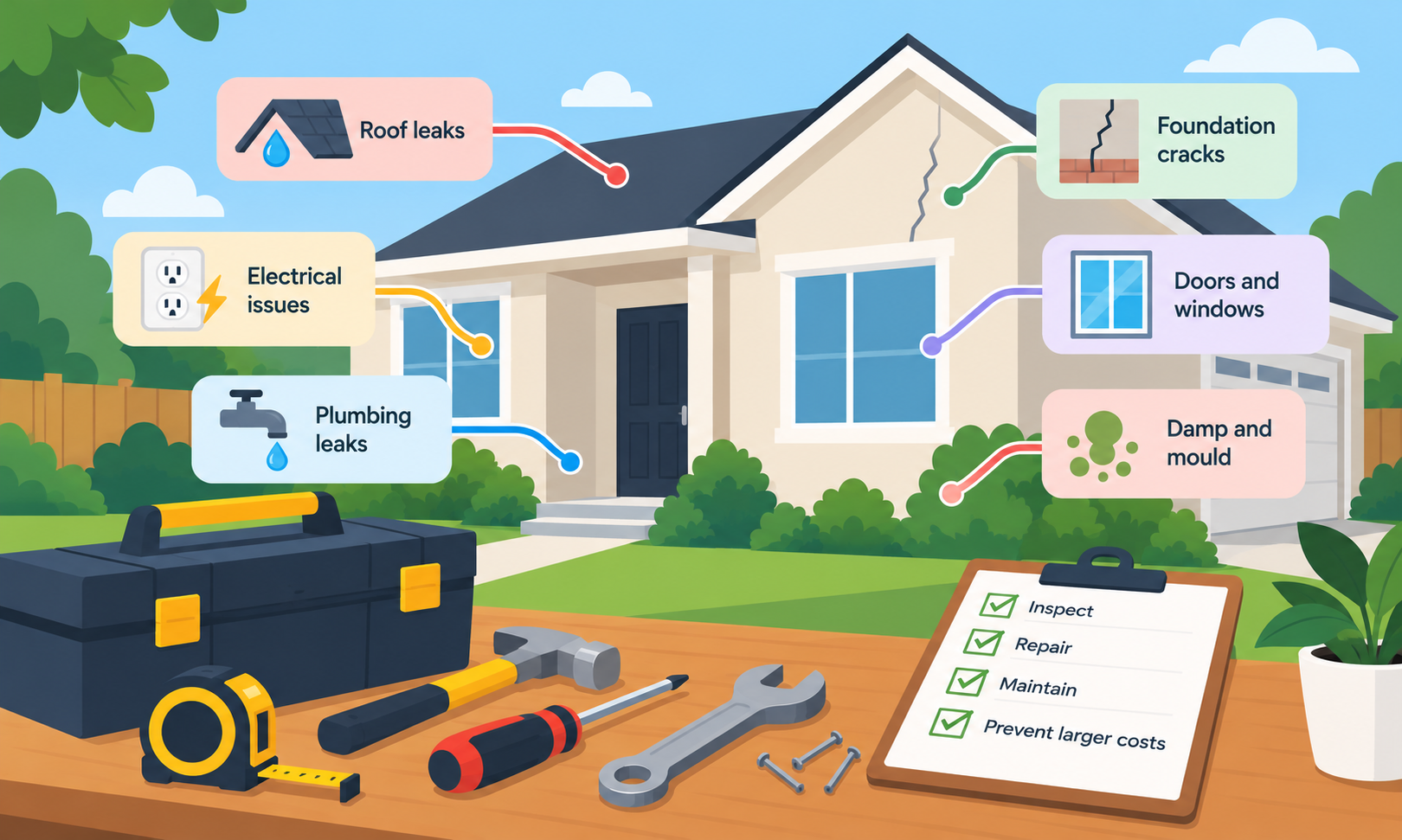
Ten home repairs you shouldn't ignore
a practical guide to spotting small problems before they become expensive or dangerous.
Why your home feels damp (and how to fix it
Condensation, mould and common mistakes.
RenovatingRenovate in the right order or pay twice
Why the boring work always comes first.