
Rental yield, explained without the jargon
Gross, net and what the brochure leaves out.

Gross yield is annual rent divided by the purchase price. It is quick to calculate and almost always flattering.
A property advertised with an 8 percent rental yield sounds like a straightforward investment. Buy it, collect the rent and enjoy the return. Except the advertised figure usually assumes every tenant pays on time, the house never needs repairs and the property taxes, insurance and management somehow pay for themselves.
They don't.
Rental yield is useful because it gives you a quick way to compare investment properties. But there are different ways to calculate it, and the number you choose can completely change how attractive a deal looks.
This guide explains gross yield, net yield, capitalization rates and cash flow for US rental properties, with a worked example showing what happens to the numbers after the real costs are included.
Key rule: Never judge a rental investment by its advertised gross yield alone. Calculate what remains after realistic expenses, then work out what the mortgage does to your cash flow.
What rental yield actually means
Rental yield measures how much rental income a property produces in a year compared with its value or purchase cost.
It is expressed as a percentage.
If a house costs $250,000 and earns $20,000 in annual rent, its gross rental yield is 8 percent.
The calculation is:
Gross rental yield = (Annual rent ÷ Property price) × 100
This makes it easier to compare properties with different prices.
A $150,000 apartment generating $12,000 in annual rent and a $400,000 house generating $32,000 both have an 8 percent gross yield.
That doesn't make them equally good investments.
One might have high property taxes, an expensive homeowners association or substantial maintenance needs. The other might have lower costs and more reliable tenants.
Rental yield is the starting point for evaluating a property, not the final answer.
1. Gross rental yield: the attractive headline number
Gross yield is the simplest calculation.
Take the expected monthly rent, multiply it by twelve and divide by the purchase price.
Consider a house with these numbers:
ItemAmountPurchase price$300,000Monthly rent$2,200Annual scheduled rent$26,400Gross rental yield8.8%
The calculation is:
($26,400 ÷ $300,000) × 100 = 8.8%
At first glance, an 8.8 percent yield looks appealing.
But this figure assumes the house produces $26,400 in rent every year and ignores the costs of owning and operating it.
It doesn't account for vacancies, insurance, property taxes, repairs or property management.
Gross yield is useful when quickly comparing listings, but it tells you very little about the money you'll actually keep.
Tip: If a property listing advertises a yield without explaining the calculation, assume it may be gross yield. Ask for the rent assumptions and expense figures before relying on it.
2. Use net yield instead
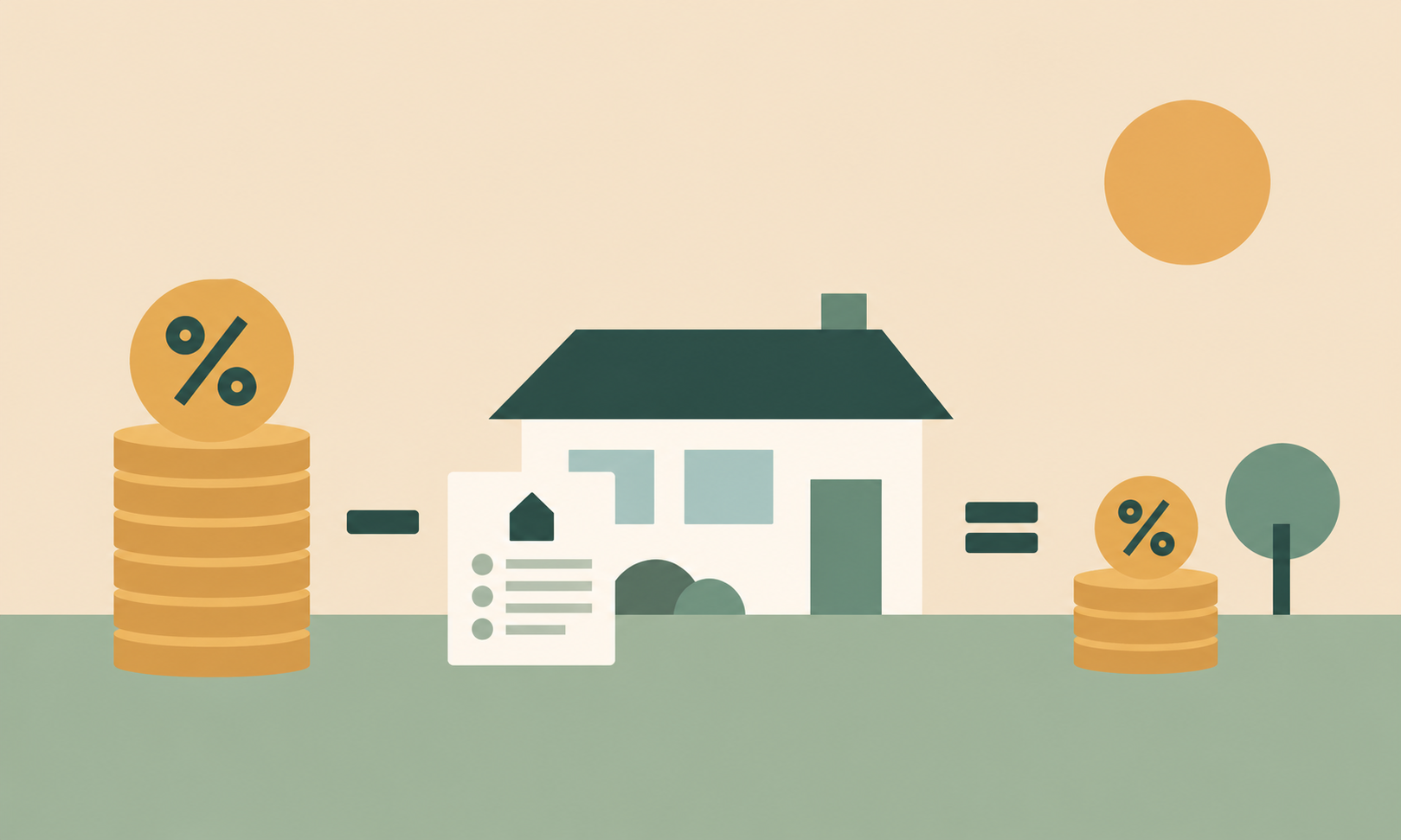
Net rental yield gives you a more realistic picture.
Instead of looking only at rent, it subtracts the costs of operating the property.
For a simple investor-adjusted calculation:
Net rental yield = (Annual rent after vacancy and operating costs ÷ Total purchase cost) × 100
Here, total purchase cost includes the property price and upfront acquisition expenses. This is one useful definition, but net yield is not standardized across every property listing, calculator or investment analysis.
Let's return to the $300,000 house.
Its advertised monthly rent is $2,200, or $26,400 per year.
Assume it sits vacant for one month between tenants.
That reduces collected rent to $24,200.
Now estimate the annual expenses.
ExpenseAnnual amountProperty taxes$3,600Landlord insurance$1,800Property management$2,000Routine repairs and maintenance$1,800Reserve for major replacements$1,800HOA fees$1,200Owner-paid utilities$600Total$12,800
After these expenses:
$24,200 − $12,800 = $11,400
Suppose the purchase also involves $15,000 in closing costs and other initial acquisition expenses, with no additional renovation costs.
The total purchase cost is $315,000.
The adjusted net yield is:
($11,400 ÷ $315,000) × 100 = 3.6%
The advertised 8.8 percent gross yield has become approximately 3.6 percent after realistic vacancy, expenses and reserves.
That's a substantial difference.
The figures are illustrative, not typical costs for every US rental. Actual expenses depend heavily on the property and location.
This adjusted yield also excludes financing costs and income taxes. The reserve for future replacements is a planning allowance rather than necessarily an expense actually paid in that year.
3. Understand the costs brochures leave out

A rental property has expenses even when everything appears to be going well.
Some are predictable. Others arrive without warning.
Property taxes
Property taxes vary enormously between states, counties and municipalities.
A property with a low purchase price may still carry a relatively high tax bill.
Don't assume the seller's current tax bill will remain unchanged after purchase.
Some jurisdictions reassess property values when ownership changes, and exemptions available to an owner-occupant may not apply to an investment property.
Check with the local assessor or tax office before making an offer.
Landlord insurance
A rental property generally needs insurance appropriate for a landlord, rather than relying on a standard owner-occupied homeowners policy.
Coverage and premiums vary by location, construction, property condition and risk.
Flood, earthquake and certain wind risks may require separate coverage or policies.
Obtain quotes before committing to the purchase.
Repairs and routine maintenance
Every building wears out.
Faucets leak, appliances fail, gutters need cleaning and HVAC systems require servicing.
Older properties may need more frequent repairs.
A maintenance allowance can help with budgeting, but there is no universal percentage that accurately predicts every property's repair bill.
Review the age and condition of the building and its major systems.
Major replacements
A roof, furnace, water heater or air conditioner can create a large expense in a single year.
These replacements don't happen annually, but ignoring them makes the property's return appear better than it really is.
Set aside money for future capital expenditures, often called CapEx.
Keep this allowance separate from ordinary maintenance so you don't count the same expense twice.
Property management
A property manager may handle advertising, tenant screening, rent collection, maintenance coordination and certain tenant communications.
Fees vary and may include leasing or renewal charges in addition to ongoing management.
Even if you manage the property yourself, consider the value of your time.
Self-management doesn't make the work disappear.
Homeowners association fees
If the property belongs to an HOA, condominium association or similar organization, dues can reduce the return significantly.
Ask about scheduled increases, reserve funding and possible special assessments.
Also check rental restrictions. Some associations limit rentals, impose lease requirements or restrict the number of units that may be rented.
Vacancy and tenant turnover
A property won't necessarily stay occupied all year.
When one tenant leaves, you may lose rent while advertising, cleaning, repairing and finding a replacement.
Some turnover costs, such as leasing fees, can occur even if the vacancy is brief.
Budget for both vacancy and turnover rather than assuming every month produces rent.
4. Vacancy can change the numbers quickly
Even a reasonably priced rental can spend time empty.
Imagine two identical properties charging $2,000 per month.
Property A stays occupied for twelve months.
Property B stays empty for two months.
Property AProperty BMonthly rent$2,000$2,000Occupied months1210Rent collected$24,000$20,000
Property B receives $4,000 less rent, even though its advertised monthly rent is identical.
Most operating expenses continue while a house is empty.
Property taxes, insurance and some utilities still need to be paid. You may also incur cleaning, advertising and repair costs.
Don't assume a property's current occupancy guarantees future occupancy.
Research local rental demand, competing listings and typical time on market.
Tip: Run your calculations with at least one additional month of vacancy beyond your expected scenario. If that turns the investment into a serious financial problem, the deal may not have enough margin for error.
5. What is a capitalization rate?
In US real estate investing, you'll frequently hear the term cap rate, short for capitalization rate.
Cap rate is closely related to rental yield, but it uses a more specific financial measure.
Cap rate = (Net operating income ÷ Property value) × 100
Net operating income, usually shortened to NOI, is the property's income after ordinary operating expenses but before financing costs and income taxes.
NOI typically excludes mortgage principal, mortgage interest, depreciation and capital expenditures.
Replacement reserves may be treated separately depending on the analysis, so check how the figure was prepared.
An example
Suppose a property has:
Annual effective rental income: $30,000.
Annual operating expenses: $12,000.
Net operating income: $18,000.
Property value: $300,000.
Its cap rate is:
($18,000 ÷ $300,000) × 100 = 6%
That means the property's annual net operating income equals 6 percent of its value.
Cap rates are widely used when comparing income-producing properties because they separate the property's operating performance from the owner's financing decisions.
Two investors could buy the same building using different mortgages, but the property's cap rate would be the same if they use the same income, expenses and valuation assumptions.
Is a higher cap rate better?
Not automatically.
A higher cap rate can indicate stronger income relative to price.
It can also reflect higher risk.
Properties in weaker rental markets, older buildings or locations with uncertain demand may trade at higher cap rates because investors require greater compensation for the risks.
A lower cap rate may reflect strong demand, expectations of growth or a property considered less risky.
Neither number proves that a property is a good investment.
6. Your mortgage changes the cash flow
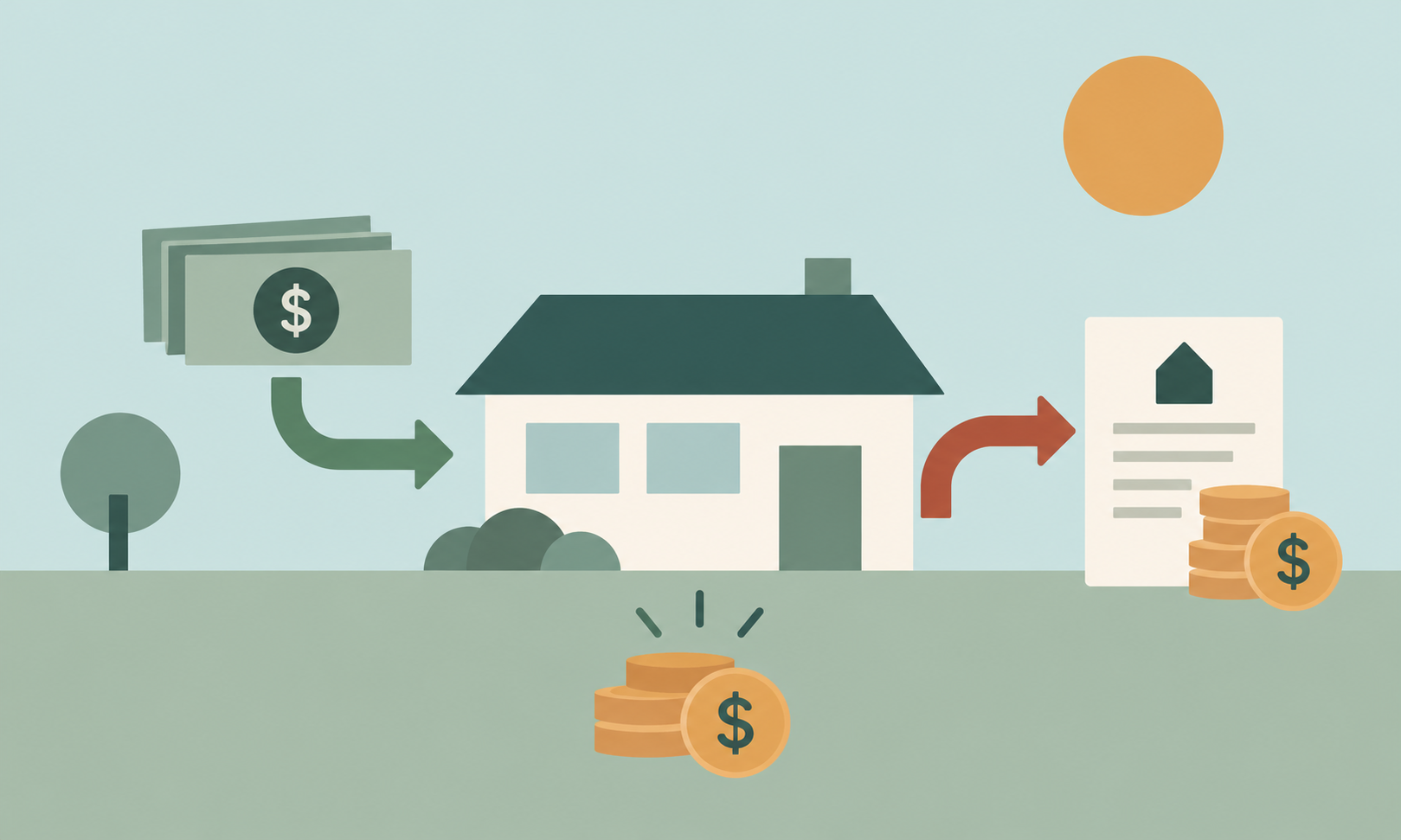
Rental yield and cap rate don't tell you whether the rent will cover your mortgage.
For that, you need to calculate cash flow.
Annual cash flow before income taxes = Property income − Operating costs − Capital spending − Mortgage payments
Be consistent about which costs have already been deducted. If you used a reserve for future replacements in your initial calculation, don't deduct the same reserve again.
Return to our original $300,000 property.
The adjusted annual income after operating costs and the replacement reserve was $11,400.
Now suppose the total monthly mortgage payment for principal and interest is $1,600.
Annual mortgage payments are $19,200.
The estimated annual cash flow becomes:
$11,400 − $19,200 = −$7,800
That's a loss of $650 per month in cash flow before income taxes.
The house can have a positive rental yield and still require you to contribute money every month.
This is why yield alone isn't enough.
The exact mortgage payment depends on your down payment, interest rate, loan term and other financing details.
Mortgage principal repayment also builds equity, so negative cash flow doesn't necessarily mean the same amount of economic loss. But equity cannot automatically pay next month's bills.
A property that builds equity but constantly drains your savings may still be unsuitable for your financial situation.
7. Cash-on-cash return: what your invested money earns
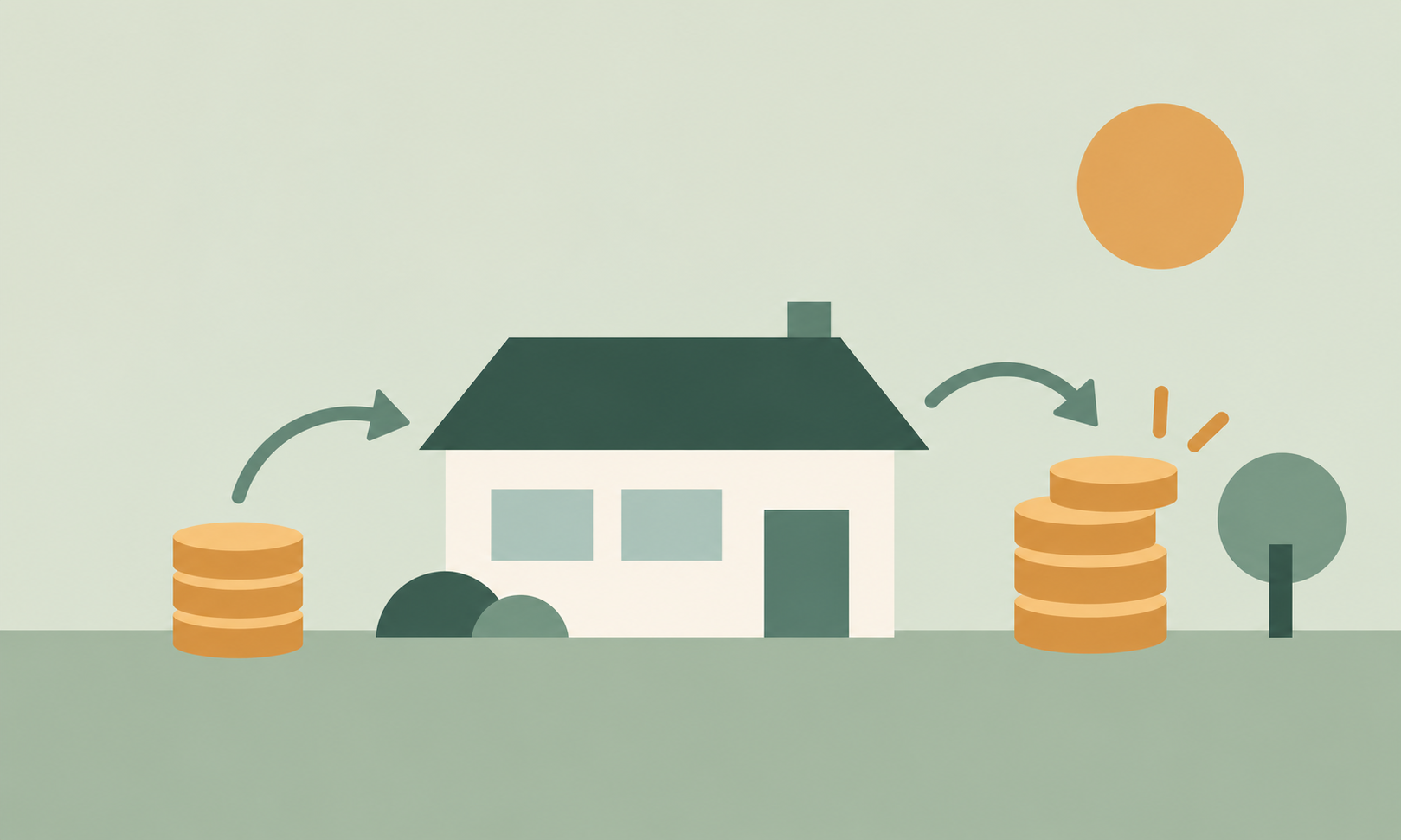
Cash-on-cash return looks at your annual cash flow relative to the actual cash you invested.
It's particularly useful when you're financing a rental property.
The basic formula is:
Cash-on-cash return = (Annual pre-tax cash flow ÷ Total cash invested) × 100
Total cash invested normally includes your down payment, closing costs and initial cash-funded improvements.
Suppose an investor pays:
ItemAmountDown payment$60,000Closing costs$9,000Initial repairs$6,000Total cash invested$75,000
After operating expenses and mortgage payments, the property produces $4,500 in annual pre-tax cash flow.
The cash-on-cash return is:
($4,500 ÷ $75,000) × 100 = 6%
The investor earns a 6 percent annual cash return on the money contributed, before personal income taxes.
This is different from a 6 percent cap rate.
Cap rate measures property operating performance without considering the investor's financing.
Cash-on-cash return measures the investor's annual cash return after financing.
It's possible to have an appealing cap rate but disappointing cash-on-cash return because the mortgage is expensive.
8. Don't confuse cash flow with taxable profit
Rental property taxes introduce another layer.
For federal income tax purposes, the IRS generally requires landlords to report rental income and allows certain qualifying expenses to be deducted.
Common categories include mortgage interest, property taxes, insurance, eligible repairs and certain management expenses.
However, tax accounting does not follow cash flow exactly.
For example:
Mortgage principal payments reduce loan debt but generally aren't deductible as rental expenses.
Qualifying improvements often must be capitalized rather than deducted immediately.
Depreciation may reduce taxable rental income without requiring an equivalent cash payment in that year.
Security deposits intended to be returned are generally not treated as rental income when received.
Rental losses can be subject to passive activity and other tax limitations.
Under the general federal rules, residential rental buildings are commonly depreciated over 27.5 years, while land is not depreciable. Specific circumstances and property components can change the treatment.
The IRS explains these rules in Publication 527, Residential Rental Property.
Your rental's taxable profit, operating income and cash flow can therefore be three different numbers.
Don't use a tax return figure as a substitute for calculating actual investment cash flow.
Tip: Keep a separate record of rental income, operating expenses, improvements, mortgage payments and cash reserves. Good records make both investment analysis and tax preparation easier.
9. What is a good rental yield?
There is no universally good percentage.
A yield that looks reasonable in one market may be unattractive in another.
Property prices, taxes, insurance, vacancy rates, maintenance costs and financing conditions differ too much to establish a single reliable national target.
You may see investors describe gross yields of 6, 8 or 10 percent as good. Those figures are only rough preferences, not investment rules.
Consider two hypothetical properties.
Property A offers a relatively high gross yield but needs major repairs, has uncertain tenant demand and carries expensive insurance.
Property B offers a lower gross yield but has a newer roof, more predictable expenses and strong local rental demand.
Property B might ultimately produce the more reliable return.
Also compare the investment with other uses of your money, accounting for differences in risk, liquidity, taxes and the work involved.
Property investing usually involves more time, concentrated risk and transaction expenses than simply purchasing a diversified investment fund.
The relevant question isn't whether the advertised yield sounds high.
It's whether the likely return justifies the money, effort and risk.
10. Check the purchase price, not just the rent
Property value is the denominator in most yield and cap-rate calculations.
Paying too much can make an otherwise decent rental perform poorly.
Suppose a house generates $15,000 in annual net operating income.
Purchase priceCap rate$200,0007.5%$250,0006.0%$300,0005.0%
The income hasn't changed.
Only the purchase price has.
Yet the cap rate falls from 7.5 percent to 5 percent as the price increases.
This is one reason investors compare recent local sales, property condition and realistic rental income before making offers.
Don't assume a house is a bargain simply because it is cheaper than other properties nearby.
A low price may reflect repair needs, legal restrictions, insurance risks or weak local demand.
11. Don't rely on the seller's rent estimate
Property listings often include an estimated rental income.
That estimate may be reasonable, but it is not the same as verified income.
Before buying, examine:
Current leases and their expiration dates.
Actual rent collected, where records are available.
Recent comparable rental listings.
Whether existing rents are above or below local market levels.
Tenant payment history, subject to applicable privacy and disclosure rules.
Vacancy and turnover history.
Who pays utilities and other recurring expenses.
Rental restrictions or licensing requirements.
For a property with existing tenants, request appropriate lease and financial documents during due diligence.
For a vacant property, compare several genuinely similar homes rather than relying on one unusually expensive listing.
Consider differences in location, bedrooms, condition, parking and amenities.
A property listed for rent at $2,500 per month doesn't prove that a tenant will actually pay $2,500.
12. Run three scenarios before buying

Investment projections are most useful when they show what could happen if conditions change.
Create three versions of your calculation.
Optimistic scenario
Assume the property rents quickly, achieves the target rent and experiences relatively few unexpected expenses.
This shows the potential upside.
Base scenario
Use realistic rent, normal vacancy, routine maintenance, appropriate management costs and reserves.
This should be your primary planning case.
Stress scenario
Assume a longer vacancy, higher insurance or property taxes, additional repairs or lower rent.
For a financed property, consider the effect of higher borrowing costs if you're using financing that could change.
A property that produces acceptable returns only in the optimistic scenario is fragile.
One that remains manageable under reasonable stress may be better suited to a long-term investor.
Tip: Don't make the optimistic scenario your official budget. Use it to understand the upside, not to justify the purchase.
13. Appreciation is not guaranteed income
Some investors are comfortable with a modest rental yield because they expect the property to rise in value.
Property appreciation can contribute to investment returns.
But it is not guaranteed, and it does not directly pay property taxes or repair bills.
Home values can stagnate or fall, sometimes for several years.
A property's eventual sale also brings transaction costs and possible taxes.
When evaluating a rental, consider appreciation separately from the income the property can support today.
A useful approach is to ask whether the investment makes sense under reasonable rent and expense assumptions without requiring rapid price growth.
If the entire investment depends on selling at a much higher price, you're relying heavily on a forecast that may not happen.
14. Compare the full investment, not just one percentage
Gross yield, net yield, cap rate and cash-on-cash return each answer a different question.
MetricWhat it tells youGross rental yieldHow scheduled rent compares with property price before expensesNet rental yieldHow income remaining after specified costs compares with the investment costCap rateHow net operating income compares with property value before financingCash flowHow much actual cash remains after expenses and debt paymentsCash-on-cash returnHow annual cash flow compares with the cash invested
None captures everything.
Yield doesn't measure future appreciation.
Cash flow doesn't fully reflect mortgage principal repayment.
Cap rate doesn't include the investor's loan terms.
Cash-on-cash return doesn't capture every future capital expense or sale outcome.
For a major investment, you may also want to evaluate total return over time, including resale proceeds, accumulated equity, transaction costs and taxes.
Start with the simple metrics, then build a more complete analysis before committing.
Common rental yield mistakes to avoid
Using gross yield as the expected return. It ignores the expenses that reduce actual income.
Assuming twelve months of rent. Vacancies and unpaid rent can occur.
Forgetting property management. Even self-managed rentals require time and work.
Ignoring major replacement costs. Roofs, HVAC equipment and other systems eventually need replacement.
Underestimating property taxes. The previous owner's tax bill may not reflect what you'll pay after purchase.
Using homeowners insurance estimates. Rental properties may require different coverage.
Counting mortgage principal as an operating expense in cap-rate calculations. Cap rate is generally calculated before debt service.
Confusing taxable income with cash flow. Depreciation and principal repayments are treated differently.
Using the asking price as proof of value. Confirm what comparable properties have actually sold for.
Trusting estimated rents without checking the market. Advertised rents aren't guaranteed collections.
Assuming property values always rise. Appreciation can be unpredictable.
Comparing net yields calculated differently. Check which expenses and purchase costs each calculation includes.
Frequently asked questions
What is rental yield in simple terms?
Rental yield is the annual rental income generated by a property expressed as a percentage of its price or cost. Gross yield ignores expenses, while net yield accounts for specified costs.
How do I calculate gross rental yield?
Multiply the monthly rent by twelve, divide by the property price and multiply by 100. For example, $1,500 per month on a $250,000 property gives a gross yield of 7.2 percent.
What's the difference between gross and net rental yield?
Gross yield uses rental income before expenses. Net yield subtracts costs such as vacancy, taxes, insurance, maintenance and management. Definitions of net yield can vary, so always check the calculation.
Is an 8 percent rental yield good?
It might be, but the number alone is insufficient. An 8 percent gross yield can translate into a much lower return after expenses. Compare realistic net income, financing costs and property risks.
Is rental yield the same as cap rate?
Not necessarily. Cap rate uses net operating income divided by property value and generally excludes financing costs. Net rental yield may use a different expense definition or include acquisition costs in the denominator.
Does rental yield include mortgage payments?
Gross yield and standard cap-rate calculations exclude mortgage payments. Net-yield definitions vary. Calculate mortgage cash flow separately so you can see whether the rent covers debt payments.
Can a property have positive yield but negative cash flow?
Yes. The property may generate positive income after operating expenses but still have mortgage payments large enough to create a monthly cash shortfall.
Does a vacant property have a rental yield?
You can estimate a prospective yield using realistic market rent, but it isn't a realized return. Include vacancy and leasing costs when evaluating the investment.
Should I use purchase price or current market value?
For evaluating a new purchase, price or total acquisition cost can be useful depending on the metric. Cap rate commonly uses property value. For an existing investment, current market value helps show the return on capital tied up in the property today.
Are rental repairs tax deductible?
Some qualifying repairs can be deductible, while improvements may need to be capitalized and depreciated. The distinction depends on IRS rules and the nature of the work.
Does depreciation affect rental yield?
Depreciation affects taxable income but doesn't require an equivalent current cash payment. It's generally excluded from ordinary property operating yield and cap-rate calculations.
Is rental income better than appreciation?
They're different sources of potential return. Rental income can provide ongoing cash flow, while appreciation may increase resale value. Neither is guaranteed, and a good investment evaluation considers both alongside costs and risks.
The quick rental yield checklist
Confirm the purchase price and realistic acquisition costs.
Research actual comparable rental properties.
Calculate annual scheduled rent.
Allow for vacancy and tenant turnover.
Check property taxes and possible reassessment.
Obtain a landlord insurance quote.
Estimate routine repairs and maintenance.
Set aside an allowance for major replacements.
Include property management costs.
Check HOA dues and rental restrictions.
Include utilities and other owner-paid expenses.
Calculate gross rental yield.
Calculate an adjusted net yield using clearly defined costs.
Calculate net operating income and cap rate.
Add mortgage payments to estimate cash flow.
Work out cash-on-cash return if using financing.
Review federal, state and local tax implications.
Test optimistic, base and stress scenarios.
Investigate the property's condition and rental demand.
Compare the potential return with the risks and other investment options.
Sources and further reading
Investment returns depend on actual rent, property condition, financing and local costs. Confirm estimates through independent research and appropriate professional advice.
Internal Revenue Service: Publication 527 — Residential Rental Property — rental income, deductible expenses, depreciation and reporting requirements.
Internal Revenue Service: About Schedule E — reporting supplemental income and losses, including rental real estate.
Consumer Financial Protection Bureau: Financial considerations of buying a home — ownership expenses, borrowing and financial planning.
Federal Emergency Management Agency: Flood Map Service Center — researching a property's mapped flood risk.
Your county assessor or local tax office — current property taxes and reassessment rules.
Local rental listings, property managers and housing market reports — researching achievable rent, demand and vacancy.
A licensed property inspector, insurance professional and qualified tax adviser — checking property condition, coverage and tax treatment.
Note: This article provides general information for US real estate investors, not personalized financial, investment, legal or tax advice. All example figures are illustrative. Rental income, expenses, property values, financing terms and tax rules vary by property and jurisdiction. Consult qualified professionals and perform independent due diligence before investing.
Keep reading

Seven things your landlord can't do
Know the limits before a dispute starts.
RenovatingRenovate in the right order or pay twice
Why the boring work always comes first.

First-time home buyer checklist: 12 things to do before an offer
A US first-time buyer checklist: 12 things to settle before you make an offer, from budget and credit to pre-approval, inspections and closing costs.